

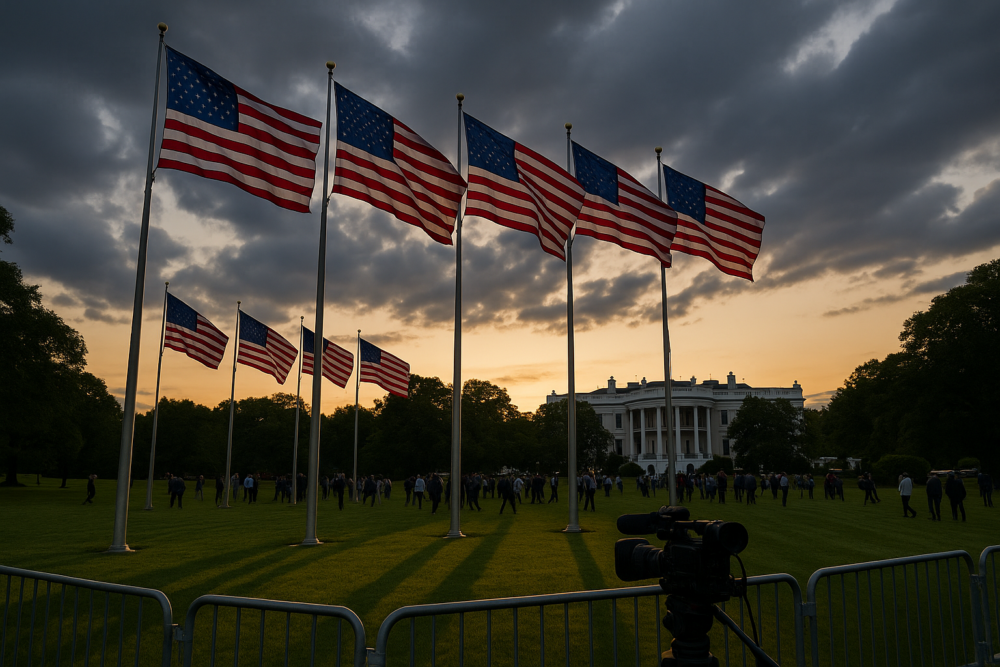
Trump Announcing Tall Flagpoles at White House: Presidential Symbolism and National Identity
President Donald Trump (Republican) has unveiled plans to install two towering American flagpoles—each nearly 100 feet tall—on the North and South lawns of the White House, aiming to create what he described as a “beautiful” and “top of the line” display of national pride. According to Trump, the installation will be personally funded, though he has not clarified if the money will come from his personal coffers or be channeled through his campaign committee—a detail that continues to invite speculation among both supporters and critics. These flagpoles, if installed, would become some of the most visible patriotic symbols on federal property, doubling down on the traditional flag display already in place at the White House.
Trump claims these flagpoles will fill what he sees as a long-standing absence of prominent flag displays on the nation’s most iconic residence. He conveyed his vision during a walk on the White House grounds, flanked by aides and Secret Service agents, a setting that underscored his characteristic blend of personal showmanship and policy messaging. Notably, the announcement coincided with his comments on trade negotiations and tariffs, further highlighting his tendency to intertwine patriotic symbolism with political priorities.
“When people see these flags from the street, from miles away, they will know this is the home of the American president and the American people,” Trump told reporters gathered for the announcement.
This move follows a pattern of personalizing the White House, including substantive interior redecorations under Trump’s watch. For instance, new gold trimmings in the Oval Office and the addition of two Trump portraits—one taking the place of Barack Obama (Democrat), whose portrait was subsequently relocated—signal a desire to imprint his tenure on the historic building. In his remarks, Trump also referenced the large American flag at his Mar-a-Lago residence as inspiration, suggesting a continuity in how he expresses patriotism across his real estate holdings.
According to a recent Associated Press report, Trump is adamant that the installation will be swift, with completion projected in about a week. The rapid timeline raises questions about the formal review process and engagement with historical preservation experts, but for supporters, it illustrates Trump’s penchant for bold, immediate action.
Personal Mark or Policy Legacy? Context and Reactions to Trump’s Flagpole Initiative
The planned flagpoles come at a time when the symbolism of the American flag has been hotly debated in the public sphere, not just as a national emblem, but as a contested icon in broader cultural and political struggles. While Trump’s initiative may resonate with those who feel patriotism should be front and center at government sites, it has also drawn skepticism from critics who question whether such gestures obscure more meaningful policy challenges or sidestep traditions of inclusive representation.
Some observers highlight the conspicuous timing and the president’s explicit intertwining of flag symbolism with his wider political agenda, such as trade negotiations and tariffs. During the impromptu Q&A session that followed Trump’s announcement, he spoke at length about ongoing talks with China and the European Union, leveraging the moment to reinforce his “America First” doctrine. For critics, this fusion of personal branding, national symbolism, and policy advocacy paints a picture of a presidency keen on merging showmanship with substance—though the lines often blur.
“We want the world to see our flag and know we mean business on trade, on security, and on respect for our veterans,” Trump declared, situating the flagpoles as part of a broader campaign to project strength and resolve both domestically and abroad.
This is not the first time symbolism around the White House flag displays has been in the spotlight. In 2019, Trump signed into law a provision requiring the POW/MIA flag to be displayed alongside the U.S. flag on certain federal properties, a move largely praised by veterans’ groups. Yet, controversy brewed in 2020 when the Trump administration relocated the POW/MIA flag to a less visible spot on the South Lawn, prompting criticism from advocacy organizations and lawmakers. Later, the Biden administration restored the POW/MIA flag to its former prominent position atop the White House, honoring a long-held tradition and responding to calls for greater recognition of prisoners of war and missing service members (see Associated Press coverage). This seesaw underscores the evolving symbolism attached to flag displays and raises valid questions about the intersection of policy, tradition, and spectacle.
Public commentary on Trump’s flagpole plan is sharply divided. Supporters praise the effort as a tangible and stirring declaration of national pride, while critics see it as a performative gesture that does little to address deeper issues facing the nation. Still, the planned installation may offer a valuable moment to reflect on what these symbols mean—and who they represent—at a time when unity and democratic values deserve careful stewardship.
Historic Precedents and Symbolic Disputes: The Role of Flags at the White House and Beyond
Debates about what the White House flag represents—and how it is displayed—have raged for decades, often surfacing during moments of national change. The American flag’s prominent placement at the White House has long served as both a symbol of continuity and a canvas for political messaging. For instance, in April 2021, President Joe Biden (Democrat) directed the restoration of the POW/MIA flag to its high-visibility spot atop the White House in a move broadly welcomed by veterans’ advocates. This reversed a controversial decision under Trump to relocate the flag, which had drawn sharp rebukes from across the political spectrum (Stars and Stripes reported it returned to its prominent place following advocacy and public pressure).
The White House has not always been the focal point for such debates, but when presidents use flags as statements of policy or ideology, they become potent—and at times divisive—symbols on the national stage.
A related flashpoint emerged in June 2019, when the Trump administration directed U.S. embassies not to fly LGBTQ Pride flags on their main flagpoles during Pride Month—a directive justified by officials as upholding the primacy of the American flag, but interpreted by many as an exclusionary message by the nation’s diplomatic representatives (Time). Such precedents add context to the current debate about what—and whom—flag displays at government properties are meant to honor.
The White House remains a living institution, with each administration shaping its traditions and structures to reflect evolving values, sometimes for progress, and sometimes for political consolidation. As communities and advocates continue to push for greater equity and inclusion, the conversation surrounding Trump’s flagpole plans spotlights how public symbols matter—not just as decorations, but as mirrors of national priorities and aspirations.
For those eager to build a more inclusive future, the key question is whether such symbolic gestures can coexist with substantive policies that advance social justice, equity, and a sense of shared American identity. Regardless of one’s view, the coming weeks will reveal not only the physical height of these new flagpoles, but also how far the nation has come in projecting unity, respect for service, and the ongoing journey toward a more perfect union.