

Trump’s Directive Targets ActBlue Fundraising Platform: Election Integrity or Political Retribution?
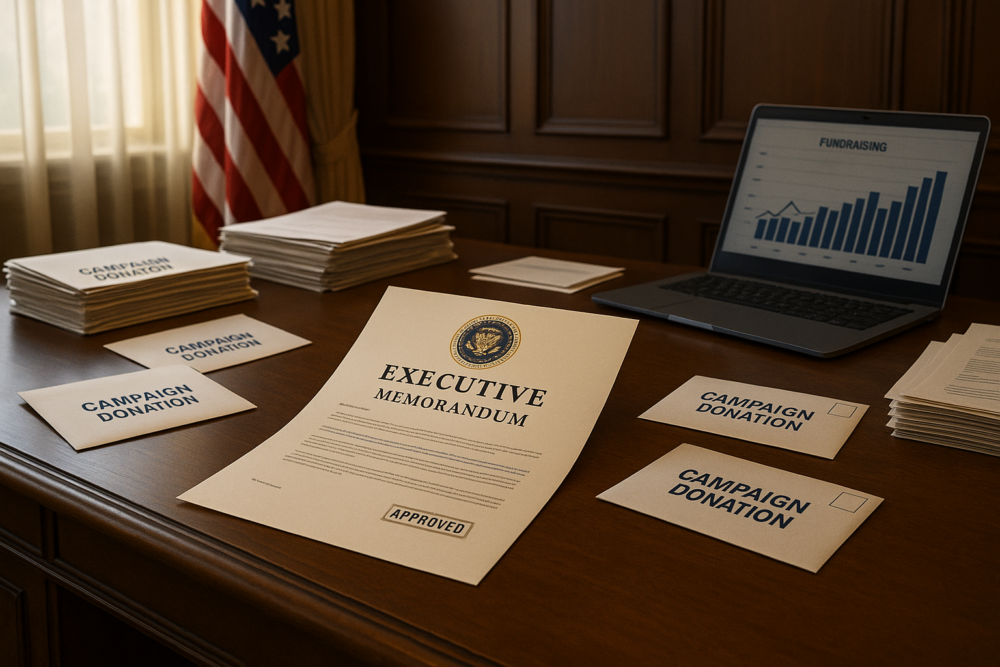
In a striking move with broad implications for campaign finance and democracy, President Donald Trump (R) has signed a memorandum directing Attorney General Pam Bondi (R) to initiate a sweeping investigation into ActBlue, the nation’s leading Democratic fundraising platform. The order alleges widespread ‘straw’ and foreign donations facilitated by ActBlue during the 2024 election cycle, singling out purported patterns of illicit contributions routed through foreign IP addresses and prepaid cards. Trump’s memorandum references ongoing Republican-led House investigations and claims the platform enables the evasion of federal campaign finance limits by fragmenting large donations and disguising their origin.
ActBlue, which plays a pivotal role in empowering grassroots fundraising and energizing small-dollar donors, immediately condemned the probe as an unlawful, politically motivated attack, arguing that it is intended to undermine the fundraising strength of Democratic campaigns nationwide. Democratic leaders, watchdog groups, and legal scholars expressed alarm over what they described as a significant overreach and a potential abuse of executive power designed to target political adversaries.
The political stakes are high. According to ActBlue, the platform raised an unprecedented $400 million in the first quarter of 2025, despite it being neither a presidential nor a midterm election year—a testament to the energy and organizing power of small-dollar donor networks (source). The Republican memorandum’s accusations, as cited by Trump, allege that such massive sums were enabled by systematic abuses of the platform’s architecture, which ActBlue vigorously disputes.
“The order is less about law enforcement than it is about political score-settling on the eve of a heated campaign.”
For progressives and supporters of campaign finance transparency, this probe is not merely a regulatory dispute but a test of whether grassroots fundraising—an engine of civic participation—will be protected or stifled by executive power. The order gives Bondi 180 days to complete her report, placing the issue at the center of public debate as the general election approaches.
Inside the Allegations: Straw Donations, Foreign Money, and ActBlue’s Response
The Trump administration’s memorandum alleges that ActBlue facilitated unlawful campaign contributions by breaking up major donations into smaller pieces and deploying prepaid cards tied to foreign IP addresses. Republican-led Congressional committees had already released reports asserting that “significant fraud campaigns” were carried out using the platform (source). These findings form the legal and political foundation for Trump’s directive.
The Republican narrative centers on so-called “straw donations,” wherein individuals’ names are allegedly used—sometimes without their knowledge—to funnel campaign cash beyond legal limits. In some instances, supposed victims have taken to social media after discovering their names attached to donation rolls for campaigns or causes they never supported. Critics argue these anecdotes, while concerning, are not evidence of systemic wrongdoing but rather rare bugs in the nation’s otherwise robust system of political giving.
In response, ActBlue has reaffirmed its commitment to compliance: “We have zero tolerance for fraud and maintain some of the strictest internal controls in the industry. Every donation is subject to anti-fraud checks and random audits.” The platform has already announced its intention to challenge the administration’s order in court, framing the probe as a distraction from urgent national issues and an existential threat to small-donor democracy.
“This is a baseless, cynical attempt to chill political participation and suppress the voices of everyday Americans,” said an ActBlue spokesperson.
Meanwhile, legal observers and election law experts warn that while foreign interference and money laundering are legitimate risks for any modern platform, there’s no public evidence yet that ActBlue’s controls are uniquely susceptible to abuse. They note the platform’s central role in democratizing fundraising, allowing ordinary citizens to pool their resources and compete with deep-pocketed interests for influence and attention in modern campaigns.
ActBlue’s position is supported by watchdog groups who emphasize that the risk of isolated fraud exists for all digital fundraising systems, regardless of party or purpose. As the probe unfolds, the tension between electoral security and the right to organize, assemble, and donate becomes ever more pronounced.
Historical Context, Partisan Battles, and the Future of Grassroots Fundraising
The unfolding conflict over ActBlue is emblematic of deeper partisan struggles over campaign finance in the digital era. Historically, both parties have faced accusations of circumventing contribution restrictions, but the rise of online platforms has supercharged small-dollar giving—especially on the left. ActBlue, founded in 2004, was a response to an era when big money, secretive PACs, and major donors dominated American elections. Its innovation allowed millions of ordinary people to aggregate their resources and make their voices heard, fundamentally changing the balance of power in political fundraising.
In recent cycles, ActBlue’s model has been replicated by right-leaning equivalents such as WinRed. Both platforms have faced sporadic reports of unauthorized donations or alleged fraud, but neither party has produced conclusive evidence of the kind of widespread illegality now alleged in the Trump administration’s order. Instead, critics argue that Trump’s recent crackdown on ActBlue should be seen alongside other high-profile executive actions—such as his controversial freeze of $2 billion in federal funding for Harvard University after policy disputes—as a pattern of using state power to pressure perceived opponents (source).
“We risk chilling volunteerism, activism, and small-donor participation if core platforms like ActBlue are threatened purely for political gain,” said a senior advisor at Common Cause.
As 2025 unfolds, the confrontation over ActBlue is likely to reverberate far beyond this election cycle. If the Trump administration’s probe sets new precedents, it could alter how digital platforms operate, how campaigns vet donors, and how future movements mobilize resources. Progressive advocates stress that defending grassroots infrastructure is not just about party advantage—it is about preserving a healthy, participatory democracy. As the legal battle gets underway, the responsibility rests with lawmakers, judges, and civil society to uphold both transparency and the American tradition of broad-based political engagement.