

Opening Overview: Record-Low Presidential Approval Poll Stirs Political Tensions
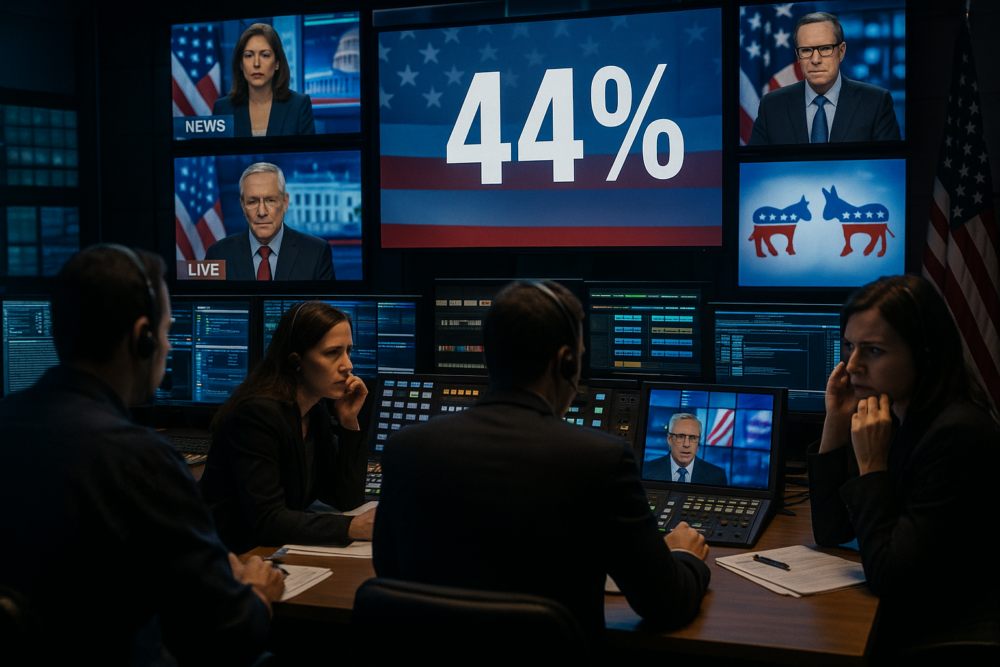
The recent Fox News poll reporting President Donald Trump’s (Republican) approval rating at just 44% during his second term—his lowest yet at the 100-day mark—has set off fresh conflict between the President and Rupert Murdoch’s conservative media empire. The same survey, executed by the bipartisan duo Beacon Research (Democratic) and Shaw & Company Research (Republican), highlights a sharp divide in public perception, with Trump’s approval trailing not only his Democratic rival Joe Biden, but also past presidents Barack Obama (Democratic) and George W. Bush (Republican) at this stage of their respective tenures. Notably, Trump publicly condemned Fox News and called the poll ‘TRASH!’, dismissing the results as unfairly negative.
While the poll gave Trump a modest majority approval on border security (55%), it revealed broad disapproval on key economic and foreign policy issues, with only 38% supporting his economic approach and just 33% approving his stance on tariffs and inflation. Vice President JD Vance (Republican) and Elon Musk, appointed to lead the newly minted Department of Government Efficiency, similarly received underwhelming marks. The network’s own anchors acknowledged these results on air, with veteran commentator Brit Hume stating such figures were “not really unexpected,” suggesting that a turnaround could come if Trump’s policies take hold.
“President Donald Trump publicly criticized Fox News after the network released a poll showing his approval rating at 44%, which he claimed was biased and ‘TRASH!’,” as recently reported.
The implications are far-reaching, as the poll—based on responses from over 1,100 registered voters—injects new urgency into debates about the President’s leadership and the conservative media’s evolving relationship with the Trump administration. Despite the sharp rhetoric, a cautious optimism persists that shifts in policy or political discourse could pave the way for improvement.
Main Narrative: Trump’s Media Fallout and Public Opinion Dilemma
A notable confrontation between President Trump (Republican) and Fox News erupted after the network published findings that deeply undermined the White House’s narrative of strong public support. The poll’s 44% approval rating, a record low for Trump at this point in his presidency, led to personal attacks from the President not just on Fox News but also on the Wall Street Journal, another Murdoch-owned outlet critical of his administration. Trump’s public rebukes followed a familiar pattern: The president has regularly dismissed negative polling as unreliable or manipulated, having previously labeled such unfavorable results as “phony” and “rigged.” (according to Fox News archives).
The Fox News poll paints a complex picture. While Trump retains strong support on border security—one of his highest-profile issues—the numbers for other critical domains are sharply negative: just 33% approve of his handling of tariffs and inflation, with 38% supporting his economic leadership and 40% approving his approach to foreign policy. These ratings are particularly significant given persistent inflation and trade disputes that have characterized the start of Trump’s second term. Fox News hosts discussed the numbers on air, with Bret Baier and Brit Hume both suggesting that while the mood in the country is wary, Trump’s numbers could recover as the administration’s policies begin to impact daily life (as noted in coverage).
The bipartisan methodology of the poll underscores its credibility, drawing from both Democratic and Republican research firms to minimize perceived bias. However, the president’s response was swift and dismissive, indicating a deepening mistrust toward even those media outlets traditionally considered friendly.
“Fox News hosts acknowledged the poor poll numbers on air but suggested potential improvement as Trump’s policies are implemented,” their report noted.
Despite clear frustrations in the White House, it is worth highlighting that the approval rating for border security suggests that parts of Trump’s base remain committed. Yet, with Vice President JD Vance (Republican) and Elon Musk also receiving low marks, the administration faces an uphill battle to regain public confidence across a range of critical issues (according to the poll). As the administration attempts to recalibrate its public messaging, the broader conservative movement is confronted with uncomfortable questions about its own internal debates and divisions.
Contextual Background: Historical Polling, Media Loyalties, and Democratic Scrutiny
The current turbulence between President Trump (Republican) and Fox News signals a wider shift in political-media alliances that have shaped conservative politics for years. Historically, the network has offered a sympathetic platform for Republican administration narratives. Yet, as public skepticism over economic management and international relations grows, even right-leaning channels are struggling to maintain alignment with the White House’s talking points.
Past presidents seldom faced such public criticism from their party’s nominal media allies so early in their second term, especially over polling considered robust thanks to bipartisan research methods. For context, President Obama (Democratic) and President Bush (Republican) both enjoyed relatively high approval at their own 100-day milestones, suggesting the current drop is notable. Trump’s repeated public disputes with polling data began during his first term and have only intensified, reflecting the increasing role of public opinion research in shaping political strategy. Past incidents, such as his denouncement of polls he disfavored as “rigged,” underscore an ongoing battle over the legitimacy of data and media narratives (well documented in Fox News reporting).
“Trump has a history of disputing unfavorable poll results, previously calling them ‘phony’ and ‘rigged’,” as archival evidence demonstrates.
The latest polling controversy also places renewed focus on the critical role of media independence and accountability. As Fox News and the Wall Street Journal navigate their dual roles as both watchdogs and ideological allies, the pressure to maintain credibility in the eyes of a polarized and often skeptical public remains high. While representatives for Fox News and News Corp have not responded to recent inquiries (as reported), the outcome of this standoff could inform future strategies for both media organizations and political leaders—potentially guiding efforts to foster greater transparency and public trust.
In this landscape, meaningful change is possible. Advocates for democratic engagement and government accountability continue to emphasize the power of informed civic participation. As polling data fluctuates and strategies evolve, one lesson is clear: a transparent, honest dialogue about policy successes and failures benefits the entire community, creating a foundation for genuine progress—even amid spirited disagreement.