

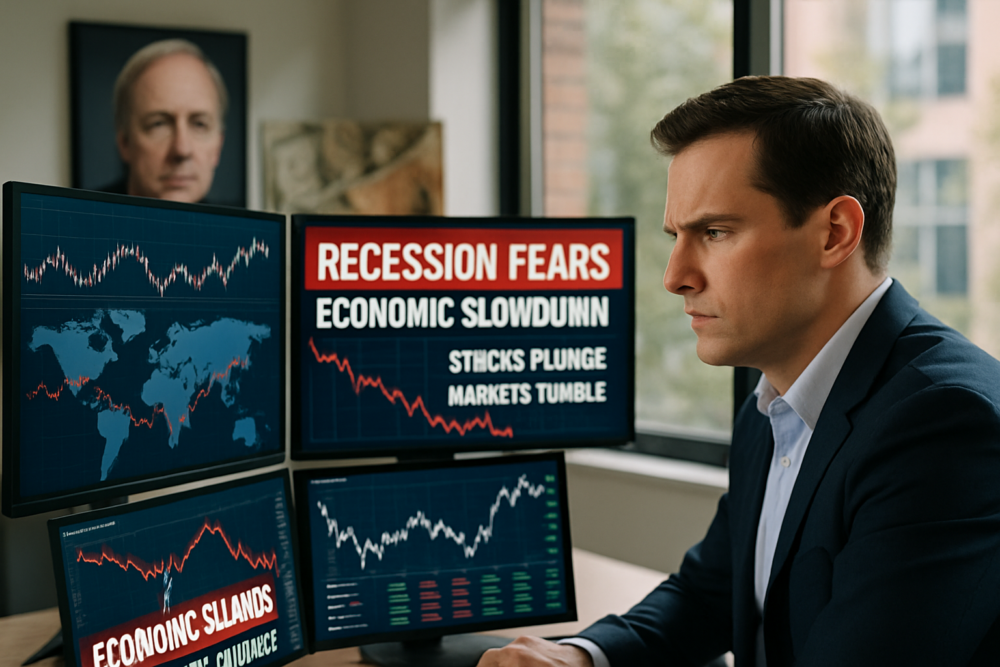
Overview: Tariffs and the Threat of a New Global Crisis
Ray Dalio, founder of Bridgewater Associates and renowned for predicting the 2008 financial meltdown, is sounding the alarm on President Donald Trump’s (Republican) aggressive tariff policies. In recent statements, Dalio has compared the current trajectory of U.S. economic and geopolitical policy not just to past recessions, but to the severe, global instability of the 1930s—a period marked by widespread economic depression and eventual military conflict. His diagnosis points to the risk that these protectionist trade measures are undermining international cooperation and increasing the possibility of economic and even military escalation.
Dalio’s concerns are echoed across the financial world. Goldman Sachs and Morgan Stanley have reportedly raised their estimated odds of a U.S. recession to as high as 60%, largely due to economic uncertainty driven by abrupt and sweeping tariff policies. The International Monetary Fund has downgraded its U.S. GDP growth forecast for 2025 to 1.8%, flagging trade tensions as a key driver of global economic headwinds. As the world’s economies struggle to process rapid policy changes, the ripple effects are already reaching businesses, workers, and consumers around the globe.
According to Dalio, this moment represents a critical decision point. “If mishandled, these policies could foster consequences more severe than a recession—potentially even conflict on a global scale,” he explained, referencing the American shift from a multilateral, cooperative order to a more unilateral, America-first approach. International observers and economic authorities are urging swift, collective action to steer away from the edge, with a focus on bipartisan solutions and deficit reduction.
Ray Dalio, founder of Bridgewater Associates, warns that President Donald Trump’s aggressive tariff policies, particularly against China, could lead to a global economic crisis reminiscent of the 1930s, with potential for severe global instability and even military conflict. Read more
Main Narrative: Rising Economic Risks and Political Division
In detailed interviews and public statements, Dalio has mapped out five “forces” now shaping the economic landscape: internal polarization, international conflict, the end of the business cycle, disruptive technological shifts, and the global move from collective to unilateral policy-making. He sees these factors converging to make the current moment uniquely volatile. The combination of high U.S. debt (now exceeding $36 trillion), historic trade friction, and domestic political discord is a recipe for instability.
Echoing Dalio’s warnings, Bridgewater’s own top investment officers have publicly cautioned that Trump’s approach to tariffs—promoting modern mercantilism and an “America First” doctrine—poses “exceptional risks” to U.S. assets. These concerns are not limited to Bridgewater. The IMF’s most recent global outlook notes that businesses are delaying investments and consumers are cutting back because of trade uncertainty. The impact is visible in the real world: Drewry, a leading maritime consultancy, projects a 1% decline in global container port volume for 2025. This marks only the third such decline since 1979—a stark sign of shrinking global trade.
These warnings are not just theoretical. The International Monetary Fund has specifically cut its U.S. growth forecast due to “rising uncertainty from trade tensions,” impacting everything from jobs to supply chains. IMF Managing Director Kristalina Georgieva has called on world leaders to resolve trade disputes urgently, emphasizing that “trade-related uncertainty is causing businesses to delay investment and consumers to reduce spending.” (Source)
Bridgewater Associates’ Co-Chief Investment Officers warn of ‘exceptional risks’ to U.S. assets due to the Trump administration’s shift toward modern mercantilism and ‘America First’ policies, increasing the likelihood of a U.S. recession.Read more
Progressive policymakers and economists across the political spectrum—including notable voices like Paul Krugman and Robert Reich—agree that tariffs’ economic damage is broad and serious. In their view, the way forward requires bipartisan cooperation in Congress to reduce the national deficit and restrain harmful, unilateral trade actions. Dalio has highlighted the risk that without such action, the country could face an “economic heart attack.” He calls for cutting the U.S. deficit from about 7.5% of GDP to 3%, urging lawmakers to overcome partisan divides for the sake of the broader national and global good.
Context and Broader Implications: Learning from History for Progressive Change
Looking back, Dalio and other critics of current policy point to the economic and political mistakes of the 1930s. During that era, protectionism and insular policy choices—exemplified by the U.S. Smoot-Hawley Tariff Act—deepened the Great Depression and contributed to international discord that later erupted into war. Dalio has said that today’s environment is starting to resemble 1930s Germany, where escalating trade barriers and populist politics led to economic collapse and conflict. This historical parallel serves as a stark warning for today’s leaders.
High debt is not just an economic concern but a drag on future generations’ opportunities. According to Dalio, “high levels of national debt, exceeding $36 trillion, pose a significant risk, describing it as a ‘ticking time bomb’ that could hinder future borrowing and spending.” The challenge lies in synchronizing economic policy with progressive aims: strengthening the social safety net, investing in renewable energy, and supporting working families, all while maintaining fiscal responsibility.
Dalio emphasizes that the current environment mirrors patterns from history, citing 1930s Germany as an example, where protectionist policies led to economic turmoil and conflict.Read more
There is a positive angle, however. The current crossroads offers an opportunity for transformative change. Policymakers can learn from history, embracing policies that balance domestic investment with global engagement. Dalio’s call for bipartisan, progressive action to reduce the deficit and strengthen international alliances reflects mainstream economic wisdom from both sides of the aisle. With Congressional action, a renewed commitment to cooperation, and broad public engagement, it is possible to mitigate the risks ahead and promote a robust, more equitable future.
As the world faces unparalleled economic and geopolitical challenges, Dalio and other leading voices are urging political leaders to look beyond short-term political wins. In their view, the difficult work of compromise and collective problem-solving is essential—not only to avoid another global crisis, but to build a stronger, fairer system for all. Every effort matters, and the window for proactive, meaningful change remains open.