

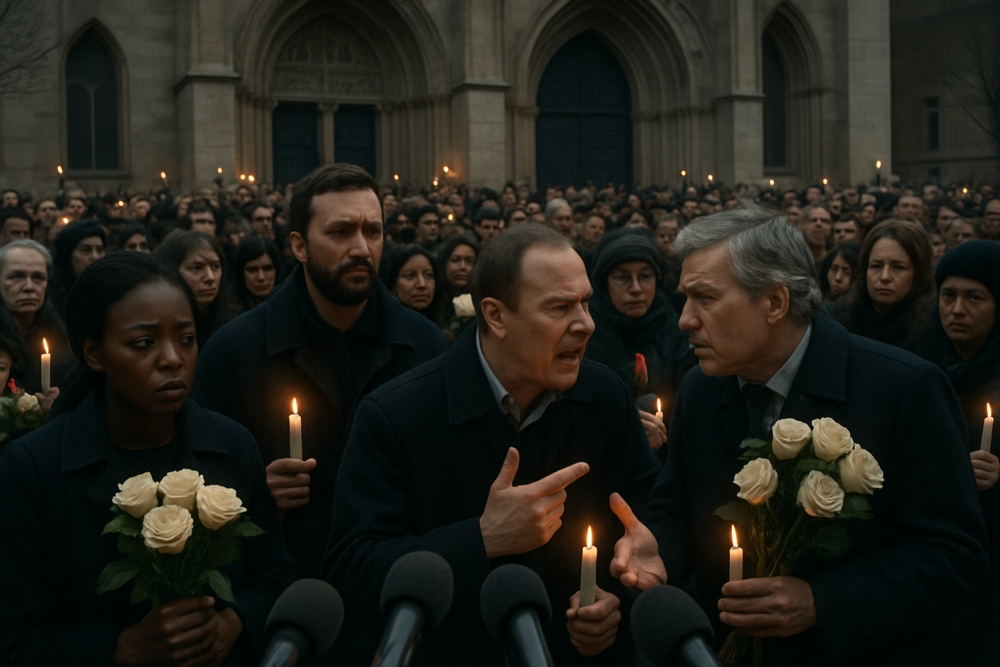
Global Mourning for Pope Francis and the Stark Political Divide
The death of Pope Francis at age 88 has reverberated across the globe, signaling the end of an era for millions of Catholics and admirers of his progressive leadership. As news of the Pope’s passing spread—following a prolonged battle with illness stretching back to February and culminating in respiratory complications—world leaders moved swiftly to honor his memory. President Donald Trump (Republican), in a rare act of bipartisanship, ordered flags to be flown at half-staff in the Pope’s honor, a gesture reflecting the deep respect commanded by the spiritual leader despite past political frictions.
Pope Francis had long been recognized as a force for modernization within the Catholic Church, earning both fervent supporters and sharp critics. His tenure was marked by advocacy for the marginalized and calls for environmental stewardship, drawing commendation from progressive quarters and creating friction with conservative figures in the U.S. His progressive stances challenged the status quo and contributed meaningfully to contemporary religious and political conversations.
The official cause of Pope Francis’s death was heart failure, preceded by a severe respiratory infection in February that progressed to pneumonia in both lungs. He remained hospitalized for five weeks prior to his passing. Global figures, including leaders from across Europe, Latin America, and Africa, issued statements of condolence, with many emphasizing the Pope’s unyielding commitment to social justice.
“His courage in speaking truth to power inspired millions and made the Vatican a beacon for social and environmental justice,” stated Cardinal Michael Czerny, a leading papal advisor known for his work on climate action.
The sense of unity that could have emerged during this period of mourning, however, was quickly disrupted by political controversy in the United States. The broader reflection on the Pope’s legacy became complicated by incendiary social media reactions from prominent political figures, highlighting persistent divisions in U.S. political and religious discourse.
Greene’s Controversial Statement and Widespread Backlash
Just hours after the Vatican’s announcement, Rep. Marjorie Taylor Greene (Republican) ignited outrage with a social media post declaring, “evil is being defeated by the hand of God.” The timing and ambiguity of Greene’s message led many to interpret it as a direct celebration of Pope Francis’s death, while others, including some defenders, claimed she was referencing the resignation of Klaus Schwab from the World Economic Forum, which occurred the same day. Nonetheless, the damage was done, with her words sparking widespread condemnation from faith leaders, fellow lawmakers, and everyday citizens.
Greene’s post was met with immediate backlash from all corners of the political and religious spectrum, with calls for her censure in Congress gaining traction. Catholic bishops and prominent religious organizations issued statements denouncing her rhetoric as inflammatory and disrespectful. The controversy was further inflamed by Greene’s well-documented history of criticism directed at the Catholic Church. In a 2022 statement, she declared that she left Catholicism because she “could not trust the Church leadership to protect my children from pedophiles, and that they harbored monsters even in their own ranks,” directly fueling accusations of anti-Catholic bigotry (source).
In addition, Greene has publicly accused U.S. Catholic bishops of “destroying our nation using taxpayer money to advocate for the illegal invasion across our borders,” arguing that religious humanitarianism is being weaponized for political ends (source). This longstanding antagonism meant that even ambiguous statements in the immediate aftermath of the Pope’s death would be seen through a lens of suspicion.
On social media, one viral retort summed up the sentiment among critics: “Marjorie, what kind of Christian dances on a man’s grave and calls it God’s will?… Here’s hoping the next Pope is woke, globalist, fully vaxxed, and trans cubed — just to see you spontaneously combust into a cloud of Hobby Lobby glitter and expired ivermectin.”
While defenders attempted to clarify Greene’s intent, the outcry demonstrates how the intersection of religion and politics remains fraught. In the face of tragedy, calls for dialogue and mutual understanding are more crucial than ever if the nation is to move past these moments of division.
Historical Context and the Urgency for Civil Discourse
The uproar over Greene’s remarks highlights a broader struggle within American politics regarding the intersection of faith, power, and public life. Political polarization has deepened in recent years, with religious divisions often mirrored in the rhetoric of elected officials. Pope Francis himself was a polarizing figure among some segments of American conservatives, particularly given his pointed criticisms of policies associated with President Donald Trump (Republican), especially on issues such as immigration and social justice (source).
While Greene is hardly alone among U.S. politicians in voicing concern about Church leadership, the intensity and frequency of her anti-Catholic statements have made her a focal point for debates about bigotry and civil responsibility. Her repeated accusations that Catholic institutions are complicit in societal ills serve as a stark reminder of how religious minorities continue to be subject to public suspicion and scapegoating.
Faith leaders have responded by urging lawmakers to hold one another accountable, emphasizing the need for dignity in public discourse: “We ask our representatives to choose words that heal, not divide, especially in moments of collective grief,” said Sister Simone Campbell, head of a leading Catholic social outreach group.
This episode fits a broader pattern in which moments that could catalyze unity are instead weaponized for political advantage. The fallout from Greene’s remarks serves as a case study in the risks posed when public figures abandon nuance for soundbites, and when grief becomes a stage for culture-war skirmishes. Yet amid the anger and disappointment, there remain hopeful calls for a more empathetic politics. Lawmakers from both parties have renewed efforts to promote interfaith dialogue and foster a more inclusive vision of public life.
Progress may be slow, but history has repeatedly shown that even in moments of great discord, committed individuals and communities can reclaim the promise of civil discourse. As the Catholic Church prepares to elect a new leader and the world mourns the loss of Pope Francis, the values of respect, empathy, and genuine dialogue are more essential than ever for healing and progress.