

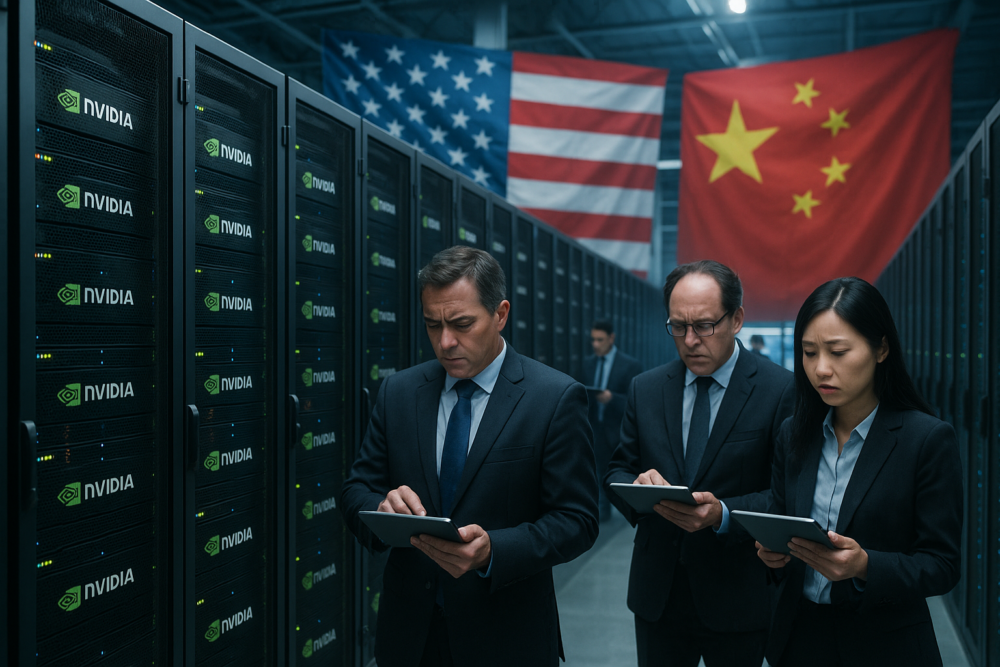
AI Chip Export Ban on Nvidia and U.S.-China Technology Rivalry: An Unprecedented Economic Impact
In a significant escalation of the ongoing U.S.-China technology rivalry, the Biden administration has imposed indefinite export restrictions on Nvidia’s H20 artificial intelligence (AI) chips, sending shockwaves through the semiconductor industry. This pivotal move, executed in response to evolving national security concerns, not only sent Nvidia shares tumbling nearly 6% but also cast a shadow over global semiconductor markets and the future of U.S.-China technological relations. As investors, policymakers, and tech leaders grapple with these developments, progressive leaders emphasize the importance of balancing national security with global innovation and supply chain stability.
The newly announced ban prohibits Nvidia and other U.S. chipmakers from exporting advanced AI chips, originally designed to meet previous U.S. compliance standards, to China. According to reports, the ban is poised to cost Nvidia approximately $5.5 billion in lost sales for the current quarter alone, underscoring the immediate economic magnitude of the move. The H20 chip’s centrality in the Chinese AI market—where it enabled companies like DeepSeek to rapidly innovate—illustrates how integral U.S.-made technology has been to China’s AI revolution. The effect was immediate and severe, with rival chipmaker AMD warning of an $800 million charge, and a global sell-off in semiconductor stocks unfolding in the wake of the announcement, as reported by industry analysts.
This policy doesn’t just threaten U.S. corporate profits—it injects new uncertainty into the world’s most important technology supply chains, placing unprecedented pressure on both American and global innovation ecosystems.
Progressive voices emphasize that while national security deserves robust protection, abrupt regulatory shifts can disrupt communities of workers, researchers, and consumers on both sides of the Pacific. The U.S. Commerce Department maintains that the controls are necessary to prevent Chinese military access to advanced computing products, a concern that resonates deeply post-pandemic and amid rapidly changing global security conditions. While this may help secure national interests in the short term, the challenge remains how best to foster scientific progress, economic growth, and open collaboration within a sustainable and equitable global order.
Inside the Export Ban: Policy Decisions, Industry Fallout, and Immediate Consequences for Nvidia and Its Competitors
The origins of the export ban trace back to ongoing bipartisan debates in Washington about technological supremacy, national security, and ethical AI development. The Biden administration’s move follows a letter from Senator Elizabeth Warren (Democratic Party) urging a crackdown on exports of advanced AI chips to China as part of a broader effort to choke off technologies that could be used in military or surveillance applications. Reports indicate that the Commerce Department’s swift response came after warnings about a possible delay in restrictions, which only heightened political and market anxiety.
The policy’s speed and timing have drawn scrutiny, particularly because the announcement closely followed Nvidia CEO Jensen Huang’s presence at a high-profile dinner with President Trump (Republican Party) where AI exports were discussed. This has sparked speculation among analysts and progressive watchdogs about the degree to which political considerations—not just security imperatives—shaped the final directive. Nonetheless, the bipartisanship visible in policy support demonstrates a shared understanding across party lines about the stakes of U.S. technological leadership.
Industry repercussions were immediate. Nvidia’s stock suffered a near 6% drop overnight, a striking loss for one of America’s leading tech companies. Rival chipmakers, including AMD, each faced their own sharp declines and profit warnings. The impact radiated globally, with semiconductor giants in Asia and Europe, such as Samsung Electronics, TSMC, and ASML, posting steep losses amid a worldwide market sell-off. As investor confidence faltered, so did the sense of certainty about the future of U.S.-China technology flows.
According to the Commerce Department, advanced AI chips like Nvidia’s H20 present risks should they be diverted to Chinese supercomputers supporting military development (see here for background).
Industry leaders worry that the disruption could ripple into U.S. supply chains and impede innovation, particularly if the abrupt withdrawal from Chinese markets is met with retaliatory measures or accelerates China’s pursuit of indigenous chip design. Meanwhile, many progressive advocates argue for a more transparent, participatory process in policymaking, ensuring that the interests of workers, researchers, and consumers are represented alongside those of national security officials and C-suite executives.
Broader Historical Context and Forward-Looking Policy Implications for the Semiconductor Industry
The present ban sits atop a complex web of historical U.S.-China technology tensions. Both nations have exchanged restrictions and tariffs for years, punctuated by escalating disputes over intellectual property, data privacy, and market access. Previous rounds of U.S. chip export controls—like those targeting Huawei—triggered comparable supply chain shifts but rarely produced such an immediate, industry-wide shock.
The H20 chip was designed to comply with earlier U.S. export controls but is now blocked by new, more stringent rules. The accelerated nature of these revisions demonstrates the ever-present pace of geopolitical change in the digital era. In response, Chinese technology companies are moving rapidly to fill the gap left by Nvidia. Domestic leaders like Huawei have introduced new alternatives, such as the Ascend 920, while other Chinese firms are investing in robust R&D to counter reliance on imported U.S. technology.
As American companies grapple with projected revenue declines, the discipline and adaptability of the tech industry will be key. Nvidia, for example, is accelerating its domestic manufacturing expansion, with production planned for Houston, Phoenix, and Dallas. These investments aim to create a million square feet of new production capacity and generate good-paying jobs for American workers while safeguarding the supply of critical components for the AI age.
This moment of uncertainty could, with the right policies, become an inflection point: a catalyst for homegrown innovation, more resilient supply chains, and more equitable labor standards—if policymakers and industry leaders heed community and worker voices.
In the final analysis, the challenge before us is not merely technical or economic, but deeply societal. How the U.S. manages its technology relationships with China will shape not only the future of global markets but also the fate of millions of workers, families, and communities who rely on a stable, thriving semiconductor industry. As the policy debate moves forward, progressive advocates continue to call for inclusive, forward-thinking solutions that prioritize security and prosperity for all.