

Unprecedented National Mobilization Against Trump, Musk, and DOGE: Millions Demand Policy Reform
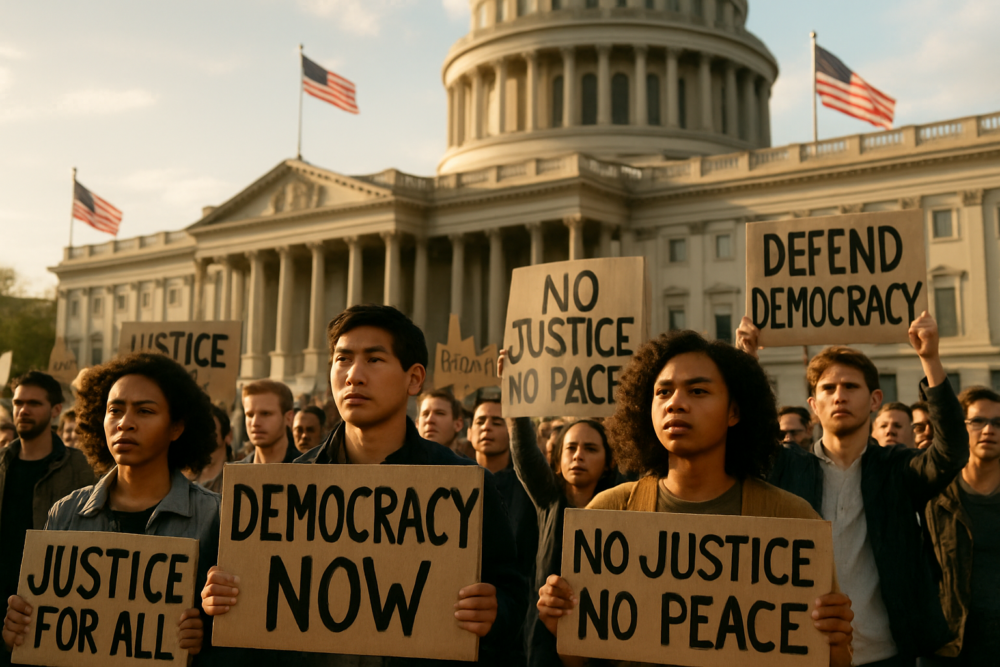
On the 250th anniversary of the American Revolutionary War, a sweeping wave of activism surged across every state, as over three million Americans rallied under the banner of the ‘50501 Movement.’ Their message was resolute: urgent policy change is vital for the nation’s future. This massive protest, among the largest since President Donald Trump (Republican) returned to office, specifically targeted sweeping executive orders, contentious immigration actions, and the much-criticized cost-cutting initiatives led by Elon Musk’s Department of Government Efficiency (DOGE).
One standout demand among many was the call for the return of Kilmar Ábrego García, who was mistakenly deported to El Salvador under policies now under scrutiny. Protesters in major cities like San Jose, Omaha, New York, and Tampa, waved banners reading “No Kings,” a pointed reference to perceived threats against American democratic traditions and a clear allusion to historical struggles against autocratic power.
Many demonstrators voiced concern about aggressive labor and regulatory policies. Elon Musk’s DOGE project, while promoted as a revolutionary effort to slash waste, led to the elimination of more than 260,000 federal jobs through layoffs and buyouts. The impact of these cuts, according to recent reporting, stretched into communities nationwide, inflicting uncertainty on families, especially in regions reliant on federal employment and public services.
“Today we’re showing that democracy is not a relic,” said Shana Montgomery, a San Jose State professor marching with her international students. “The country’s real strength is its willingness to stand up for those being pushed out or silenced.”
The rallies also highlighted the unity among a diverse coalition—students, union members, faith leaders, small business owners, and even voters who previously supported Trump. Despite pockets of tension, most events remained peaceful, underscoring the power of civic engagement and a persistent, collective hope for progress.
Policy Backlash: Public Discontent With DOGE, Immigration Crackdown, and Eroding Federal Protections
The scope of the nationwide protests is deeply rooted in mounting dissatisfaction with the Trump administration and Musk’s stewardship of DOGE. Participants condemned what they see as undemocratic impulses, citing executive orders that consolidated power and slashed regulations without meaningful public input. Of particular concern was the rollback of protections for immigrants and refugees, highlighted by the ongoing campaign to reverse the mistaken deportation of Kilmar Ábrego García. The administration’s reluctance to correct these actions has fueled accusations of callousness and disregard for due process.
The Department of Government Efficiency’s cost-cutting was once heralded as a bold fix for government bloat. However, as demonstrators and watchdogs have pointed out, DOGE’s verified savings have amounted to less than 0.1% of federal spending, a fraction of its touted $2 trillion goal. For many, the real costs have come in the form of diminished services, shuttered local offices, and increased strain on already vulnerable populations.
“There’s a narrative that these cuts are making America more efficient. But what about the communities left behind when a local Social Security office disappears? What about the students whose visas are revoked?” posed Omaha organizer Malik Reynolds, referencing the impact on San Jose State’s international student population and others nationwide.
This growing backlash was particularly evident in Omaha, where the protest took on a distinctly left-leaning character, punctuated by calls for alliances across party lines. Organizers emphasized coalition-building, uniting “regretful Republicans” with progressive Democrats under shared concern for American democratic norms and basic fairness in public policy.
An additional flashpoint was the Trump administration’s move to relax regulations on autonomous vehicles—a decision critics say disproportionately benefits Tesla, a company led by Musk himself. The relaxation, reported by El País, has intensified scrutiny of the intertwined interests of government and big business.
Despite these challenges, there was a renewed sense of hope among protesters following a recent Supreme Court decision that temporarily halted deportations under the revived Aliens Act of 1798. Many view this as proof that legal checks on executive power remain effective if the public stays vigilant.
Historical Echoes and Forward Momentum: The 50501 Movement and the Future of Civic Action
The ‘50501 Movement’ has rapidly emerged as a powerful force in an era of surging political protest. Recent months have seen events like the ‘Hands Off’ demonstrations, which drew tens of thousands in April, signaling a sustained and growing movement against Trump administration policies. The wide range of participants—from grassroots activists to seasoned political organizers—underscores a rare moment of unity and urgency in American civic life.
While many protesters carried signs evoking revolutionary-era ideals, the movement’s strategies and objectives are unmistakably modern. Organizers have emphasized the importance of coalition-building, inclusivity, and nonviolent resistance. In interviews, leaders pointed to the resonance of democratic principles and the ongoing struggle for social and environmental justice.
“We’re watching the legacy of the American Revolution unfold in real time,” said historian Dr. Lila Endicott. “These protests are a direct response to threats—real or perceived—to the democratic fabric of the country. They’re a call for public officials to remember for whom they serve.”
Even as some question how much immediate policy change can result from these demonstrations, the historical context provides hope. Previous waves of activism, from civil rights to anti-war mobilizations, have repeatedly altered the nation’s course by forcing public debate and policy reconsideration. The inclusion of advocacy for wrongly deported immigrants, environmental protections, and transparent governance in this movement’s aims is both a nod to these precedents and a sign of the participants’ determination to shape America’s future.
The Trump administration has yet to formally respond to the latest protests. Yet, developments like Musk’s planned departure from DOGE by the end of May 2025—months before the agency’s scheduled expiration—suggest that sustained public pressure and economic consequences (such as the recent 71% decline in Tesla’s net income amid boycotts) are already having tangible effects. This dynamic moment in American history reaffirms that when diverse communities unite with purpose, their voices can spark hope—and change—even in the face of daunting odds.