

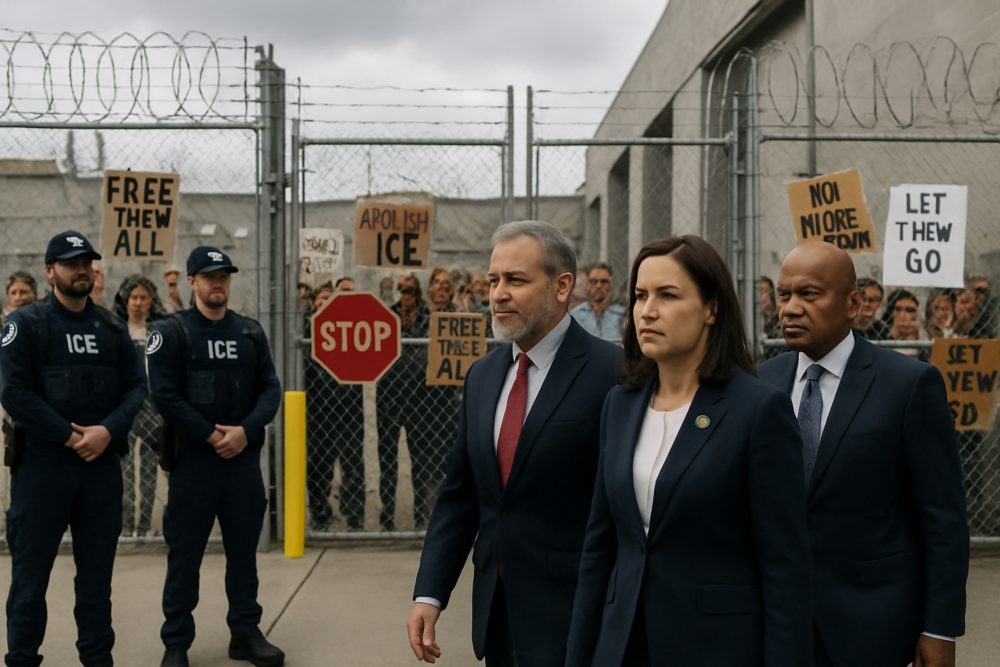
Congressional Delegation Confronts ICE Over Detention of Pro-Palestinian Student Activists
Concerns over civil liberties and immigrant rights have surged after a congressional delegation visited a Louisiana detention facility to meet two pro-Palestinian student activists held by Immigration and Customs Enforcement (ICE) without criminal charges. On April 22, 2025, members of Congress, including Sen. Ed Markey (D), Rep. Ayanna Pressley (D), Rep. Jim McGovern (D), Rep. Troy Carter (D), and Rep. Bennie Thompson (D), made the high-profile visit to advocate for Rümeysa Öztürk, a Turkish doctoral candidate at Tufts University, and Mahmoud Khalil, a legal permanent resident and Columbia University graduate. Both have been detained for their pro-Palestinian advocacy, sparking debate around free speech, due process, and U.S. foreign policy priorities in the post-Trump policy landscape.
Öztürk’s detention followed the publication of a co-authored op-ed supporting Palestinian rights, while Khalil was apprehended after leading demonstrations at Columbia. Despite the federal government accusing Öztürk of supporting Hamas, no evidence has been publicly presented. Citing echoes of McCarthy-era repression, lawmakers directly challenged ICE’s motives, highlighting the threat such detentions pose to constitutionally protected dissent, especially for noncitizens.
“What we saw was heartbreaking. These students are not criminals. They are being punished for their political speech, which is protected by our Constitution,” Rep. Ayanna Pressley (D) remarked to reporters after the visit.
Both students are being held under a rarely invoked statute allowing the Secretary of State to order deportation on national security or foreign policy grounds—even in the absence of criminal prosecution. The move has drawn criticism nationally and internationally, with Turkish authorities, in particular, monitoring Öztürk’s case closely.
Inside the Detentions: Civil Rights, Poor Conditions, and Family Separation
The nature of the detentions has heightened scrutiny of ICE’s practices, especially regarding the use of warrantless arrests and limited legal access. Khalil, who was detained March 8, 2025 without a judicial warrant, has now been held for over six weeks at the Louisiana facility. According to reports, the Department of Homeland Security justified the warrantless arrest by alleging Khalil might flee—a rationale disputed by civil rights groups. Khalil’s legal team and family say he was denied humanitarian release to attend the birth of his first child, a decision that has drawn sharp condemnation from advocates and lawmakers alike.
Öztürk’s story is equally troubling. She was detained by plainclothes ICE agents on March 25, 2025, while on her way to break her Ramadan fast. She was moved through multiple states overnight before arrival in Louisiana, a process during which she suffered a serious asthma attack. Concerns remain regarding her access to adequate medical care; reports indicate her asthma went untreated during transfer, amplifying fears about the overall conditions at the facility. Sen. Markey specifically pointed to the denial of basic requests for blankets and the general lack of healthcare for detainees, underscoring persistent failures in America’s immigration system.
“There are people here who are cold and sick, and all they get is indifference. These conditions violate human dignity,” Sen. Ed Markey (D) told the press.
The Department of Justice’s recent decision to appeal a court order requiring Öztürk’s transfer to Vermont—where her legal status can be fairly reviewed—has further prolonged her detention, leading advocates to warn that the government is effectively circumventing judicial oversight. The congressional delegation forcefully criticized ICE’s approach, demanding the students’ immediate release while also drawing attention to broader civil liberties issues facing all noncitizens in the United States.
Historical Parallels, Policy Alarm, and the Path Forward for Civil Liberties
Current events evoke memories of past periods in U.S. history when political speech was met with overreach and repression. Legal experts and human rights advocates describe the students’ detentions as reminiscent of McCarthy-era tactics—punishing individuals for their associations or beliefs rather than for proven crimes. This has set off alarm bells among civil rights organizations and progressive policy makers who emphasize the critical role of dissent in a healthy democracy.
In historical context, the law used to justify these detentions—a provision that allows deportation on the basis of being “contrary to the foreign policy interests of the United States”—dates back to the Cold War. It has rarely been used in the modern era, yet its legacy is fraught with instances of abuse and injustice. Groups like the ACLU have long called for reform, arguing that such powers undermine fundamental due process protections and open the door to political persecution.
“If we start criminalizing speech and activism, especially among noncitizens, we not only erode the promise of our Constitution, but also risk repeating our darkest mistakes as a nation,” said a spokesperson for the Center for Constitutional Rights.
The chilling effect of these detentions is already being felt on university campuses and within immigrant communities, where students and scholars fear reprisals for expressing unpopular or controversial views. Civil society leaders argue that this climate stifles debate and innovation, which are critical for social progress. The situation has also prompted calls for Congress to revisit immigration and national security laws, ensuring that policies designed for a different era are not used to silence dissent in contemporary America. At the same time, the proactive efforts of lawmakers and the growing national attention suggest that solutions—grounded in collective advocacy—are possible. Ensuring due process and the protection of First Amendment rights for all residents, citizen or not, remains a challenge democracy must meet head-on.