

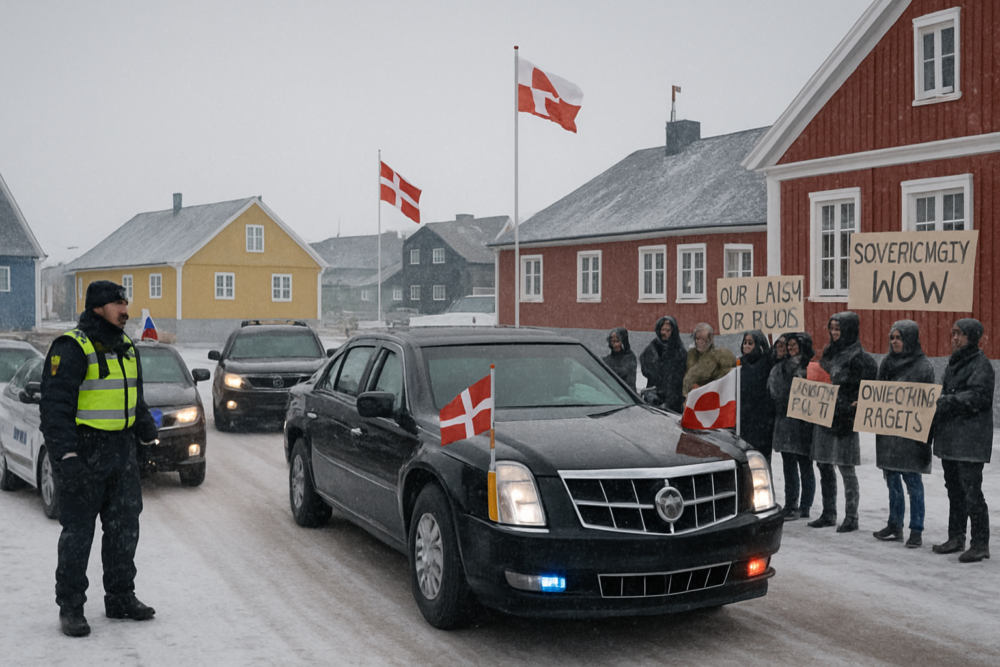
Rising Tensions Over US Delegation’s Greenland Visit: Security, Sovereignty, and Geopolitics in Focus
The US vice president’s surprise trip to one of the world’s most strategically vital regions has reignited debate over American ambitions in the Arctic. Vice President JD Vance (Republican) and his wife, Usha Vance, are set to visit Greenland, a move that has drawn sharp criticism from both Greenlandic and Danish officials. The visit, which the Greenlandic government says was not officially invited or welcomed, comes on the heels of President Donald Trump (Republican) once again advocating for bringing Greenland under US control, supposedly for reasons of national and international security. This maneuver is perceived by many as a renewed challenge to Greenland’s autonomy, and as pressure on Denmark’s stewardship of the icy island.
The official itinerary for the trip was quickly adjusted after the initial backlash. The Vances will now focus their visit exclusively on Pituffik Space Base, a U.S. military installation that lies at the heart of America’s strategic interests in the Arctic (ABC News). Still, the presence of National Security Advisor Mike Waltz (Republican) as part of the delegation signals that Washington takes the opportunity to discuss both security cooperation and the broader role of Greenland in Arctic geopolitics seriously.
Vice President Vance’s stated intention to “enhance the territory’s protection” against threats from “a lot of other countries” was not met with open arms. Danish Prime Minister Mette Frederiksen (Social Democrats) called the visit “an unacceptable pressure.” The controversy is amplified by Greenland’s political climate: the island’s government, currently in a caretaker phase, demanded respect for its internal processes during this critical transition period. Vance, however, attempted to inject some levity into the situation by joking in a widely shared video that he joined his wife “because he didn’t want her to have all the fun alone.”
“Our visit is about cooperation and cultural exchange, but we are concerned with the threats facing Greenland,” said Vice President Vance, seeking to frame the trip in positive terms, even as tensions simmered beneath the surface.
As the United States underscores its desire for deeper Arctic engagement, the events surrounding this visit highlight longstanding concerns over sovereignty, environmental stewardship, and the future of indigenous communities. There is optimism that dialogue and respect for self-determination can create pathways forward, even in moments of high political drama.
Diplomatic Fallout: Greenlandic, Danish, and US Responses to Heightened Arctic Pressures
Regional leaders responded with sharp words as the United States moved forward with its controversial visit. Denmark’s Prime Minister Mette Frederiksen (Social Democrats) stated bluntly that the trip amounted to unacceptable foreign pressure on both Greenland and Denmark, warning against undermining Greenlandic autonomy (AP News). This sentiment was echoed by Greenlandic officials, who reiterated that no formal invitation had been offered, emphasizing that Greenland is in a period of political transition with a caretaker government.
The US delegation, in turn, emphasized security and shared Arctic interests. However, this rationale rings hollow for many in Greenland, where fears of American overreach are not new. President Trump (Republican) has repeatedly stated his desire for the U.S. to control Greenland, citing national security goals (AP News). In response, Greenlandic political parties formed a coalition government and newly selected Prime Minister Jens-Frederik Nielsen (Democrat) firmly rejected any notion of Greenland relinquishing its autonomy, calling American overtures both unwelcome and undemocratic (AP News).
Meanwhile, Denmark is taking steps to reaffirm its support for Greenland. King Frederik X is scheduled to visit and meet with newly elected Prime Minister Nielsen in a show of solidarity, reflecting the urgency with which Copenhagen views the current geopolitical uncertainty.
“We appreciate American friendship but must be vigilant about our sovereignty,” stated PM Nielsen. “Greenland’s future will be decided by its people, not by foreign leaders.”
In the United States, the congressional mood is more skeptical than the executive branch’s ambitions suggest. During a recent visit to Copenhagen, House Minority Leader Hakeem Jeffries (Democrat) asserted that Congress would not support any sort of invasion or annexation of Greenland, underscoring the lack of bipartisan appetite for such drastic action (Reuters).
Polls reflect this caution at home: in January, about 53% of US voters opposed the idea of acquiring Greenland, indicating a sharp divide in public sentiment (Wikipedia). For many progressives in the US, the episode is a call to embrace international partnership and the self-determination of indigenous peoples, rather than pursuing outdated ideas of territorial expansion.
Historical and Policy Background: Arctic Ambitions, Indigenous Rights, and the Balance of Power
The current turmoil is only the latest episode in a century-long pattern of contested interests in Greenland. The US has maintained a strong military presence in the region for decades, most notably with the Pituffik Space Base, which serves as a key hub for missile warning and space surveillance in the Arctic (Wikipedia). Yet the history of US-Greenland-Denmark relations is marked by moments of both cooperation and strain, often driven by the evolving geopolitical significance of the Arctic as climate change melts sea ice and opens new trade and military routes.
Greenland’s people—predominantly of Inuit heritage—have made significant strides toward greater self-rule, achieving home rule in 1979 and self-government status in 2009. While Denmark retains control of foreign policy and defense, Greenland’s parliament and government make most domestic decisions. The repeated US interest in purchasing Greenland—first floated as early as 1946, and revived by President Trump (Republican) in 2019 and again in 2025—has often been met with anger or incredulity in both Greenland and Denmark.
“We are not for sale,” has become a rallying cry for Greenlandic politicians and activists, underlining the drive for greater autonomy and recognition of indigenous rights.
Environmental and social justice advocates in both the US and Europe caution that the pursuit of strategic bases or natural resources must not override the rights and voices of local communities. Progressive policymakers have urged a shift away from zero-sum geopolitics, calling instead for Arctic cooperation, sustainability, and respect for self-government.
In light of the latest controversy, there are renewed calls on Capitol Hill and in international bodies for transparent dialogue and the prioritization of peaceful Arctic development. Indeed, some point to possibilities for positive engagement, such as joint climate research, sustainable economic partnerships, and deeper cultural ties with Greenland’s indigenous peoples—as long as these efforts are rooted in consent, respect, and shared benefit.