

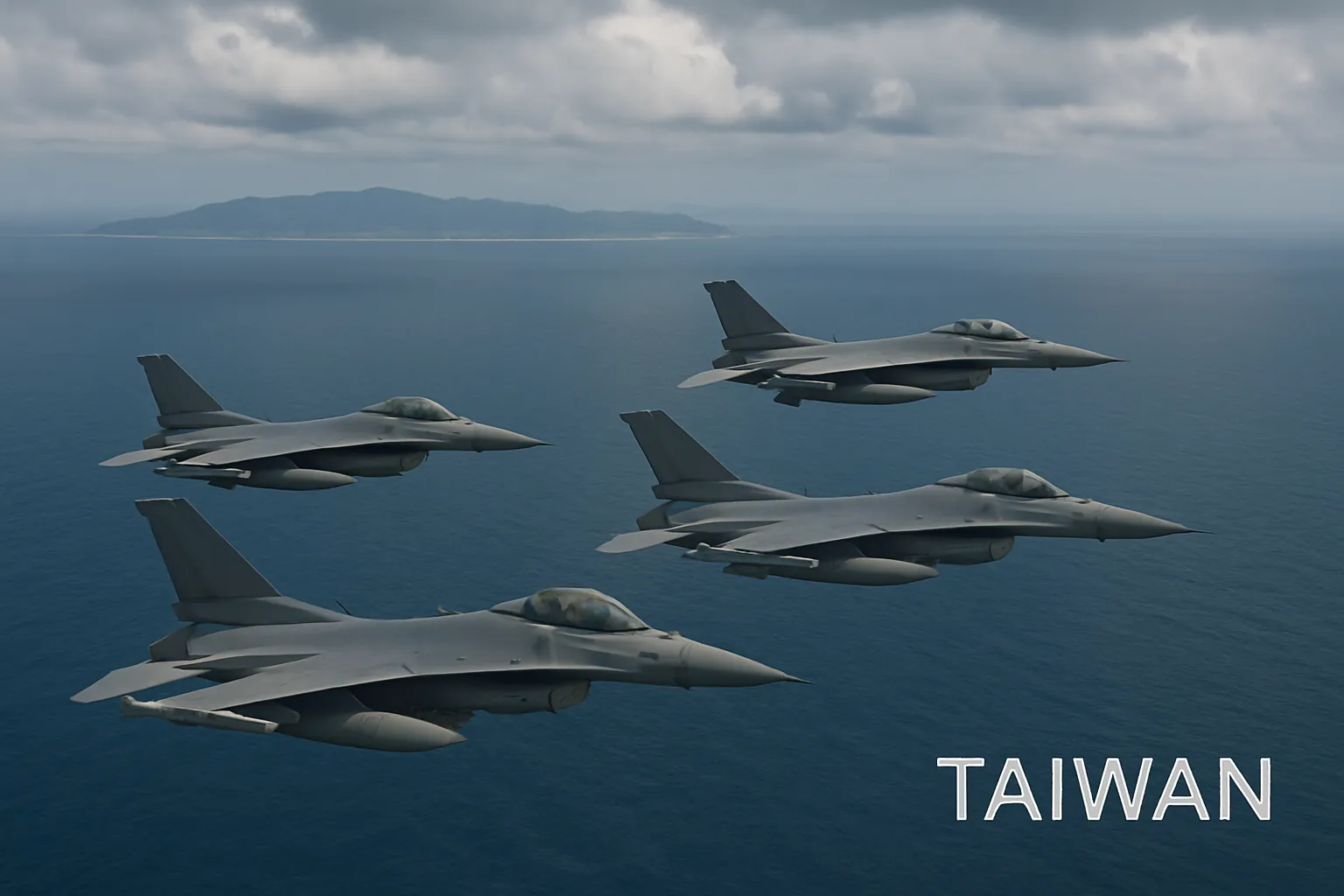
Escalating Tensions in the Taiwan Strait as Warplanes Cross Unofficial Boundary
The Taiwan Strait has once again become a focal point of international concern after China dispatched an unusually large number of military aircraft across the waterway’s central line, escalating longstanding tensions between Beijing and Taipei. This recent surge in military posturing underscores both the fragility and the strategic significance of the region, as Taiwan and its supporters work to preserve peace, stability, and the principle of self-determination in the face of intensifying pressure.
Between late Thursday and early Friday, China dispatched 74 warplanes toward Taiwan, with 61 crossing the central line in the Taiwan Strait, representing a significant and unusual escalation according to multiple reports. The central line has long served as an unofficial buffer, reducing the risk of accidental conflict. The sheer scale of China’s operation—consisting of fighter jets, drones, support planes, and the accompaniment of six naval vessels—signals both a tactical show of force and a political message aimed at Taipei and its allies.
This dramatic uptick in military activity follows what many see as a deliberate reaffirmation of international norms by the United Kingdom. Just days before, the British Royal Navy’s patrol vessel HMS Spey transited the Taiwan Strait—a move hailed by Taiwan’s Ministry of Foreign Affairs as a clear expression that the waters are international and open to all lawful navigation. China, for its part, condemned this transit as a provocation, accusing Western powers of destabilizing the region.
Amid these developments, Taiwan’s defense forces have ramped up their response by deploying patrol aircraft, naval vessels, and coastal missile systems to monitor and counter these provocations (source). The island’s leadership remains adamant about resisting intimidation and upholding its autonomy.
“Taiwan and its people simply want continued peace, stability, and the chance to choose their own path. Persistent shows of military might by China do nothing to build trust or foster dialogue,” said an anonymous senior advisor in Taiwan’s security apparatus.
The escalation is not happening in isolation. Neighboring countries—especially Japan—are also carefully tracking these developments, particularly as two Chinese aircraft carriers have been observed operating in the Pacific simultaneously. Such maneuvers have prompted regional democracies to coordinate more actively and reinforce their shared commitments to a free and open Indo-Pacific region.
International Responses: The Balance of Power and Freedom of Navigation
The most recent surge of Chinese military activity has triggered a range of reactions across the Indo-Pacific, driving home the global stakes involved. Taiwan’s Ministry of Foreign Affairs promptly welcomed the passage of HMS Spey, urging the U.K. and other like-minded countries to continue such transits to demonstrate their support for freedom of navigation in the Taiwan Strait. The ministry emphasized that maintaining these international norms is essential for long-term peace and regional stability.
Taiwan accuses Beijing of not only military intimidation but also cyberattacks and disinformation campaigns aimed at undermining the island’s defenses as recently reported. This multi-pronged approach by China—combining kinetic, cyber, and informational tactics—reflects a new era of hybrid threats that democracies worldwide must confront collectively.
In the wake of these provocations, President William Lai (Democratic Progressive Party) has ordered enhanced intelligence gathering and real-time monitoring of military and digital threats. This decisive leadership demonstrates a resolve not only to defend Taiwan’s sovereignty but also to reassure its citizens and regional partners.
“We remain fully committed to working with the international community to deter aggression and keep the Taiwan Strait safe for all,” President Lai said at a recent national security briefing.
Regional responses extend beyond Taiwan. Japan’s Self-Defense Forces, for example, have increased surveillance activities and shared intelligence with allied partners as they observe concurrent operations of two Chinese aircraft carriers—a scenario that significantly raises the potential for inadvertent clashes or misunderstandings. These actions have led experts and policymakers to repeat calls for robust multilateral engagement and dialogue to de-escalate tensions.
While China’s Eastern Theater Command framed its response to HMS Spey’s voyage as a necessary countermeasure against foreign interference, outside observers see such statements as part of a broader effort to challenge established rules and test the willingness of like-minded nations to push back.
Historical and Policy Context: The Taiwan Strait, International Law, and Democratization
The Taiwan Strait—an approximately 180-kilometer-wide channel separating Taiwan from mainland China—has for decades symbolized both geopolitical rivalry and the ongoing contest between democratic self-determination and authoritarian assertion. The central line, though never legally binding, has functioned as an important safety valve, respected by both sides for decades to avoid unintentional escalation.
The British Royal Navy’s recent passage in the Taiwan Strait is only the latest in a series of freedom of navigation operations by democratic nations seeking to reinforce the strait’s international status (source). The United States, Australia, France, and Canada have all carried out similar exercises, echoing the global consensus that peaceful transit in international waters is a principle worth safeguarding.
Over the past decade, China’s growing military and naval capabilities have translated into an increasing willingness to test the boundaries of international law—both literally and figuratively. Experts note that such large-scale incursions into Taiwan’s air defense identification zone (ADIZ) have become more frequent and more assertive as China seeks to apply maximum pressure on Taiwan’s government and society. For Taiwan’s youth and progressive activists, these events underscore the importance of international solidarity and the ongoing struggle for democratic values in East Asia.
“Every nation in the region has a stake in ensuring the Taiwan Strait remains peaceful. The world is watching how we respond—not just as governments, but as global citizens,” said a spokesperson for Taiwan’s prominent civil society coalition defending self-determination.
Policymakers and analysts point out that the steady escalation of hybrid threats, including cyberattacks and disinformation, makes it vital for democracies to upgrade their resilience and foster deeper cooperation. Western support for Taiwan, through diplomatic statements and visible naval transits, serves as a deterrent even as China’s own military developments proceed rapidly. The situation highlights how small actions—be they naval passages or support for fact-based journalism—can accumulate into broader resistance against intimidation and autocracy.
Despite the risks and uncertainties, there remains a persistent optimism among Taiwan’s allies—and within Taiwan itself—that pragmatic, patient, and principled engagement can preserve peace. The global community’s resolve to uphold international law, deter aggression, and support those facing intimidation is being put to the test, but history has shown that cooperation and solidarity can make a meaningful difference.