

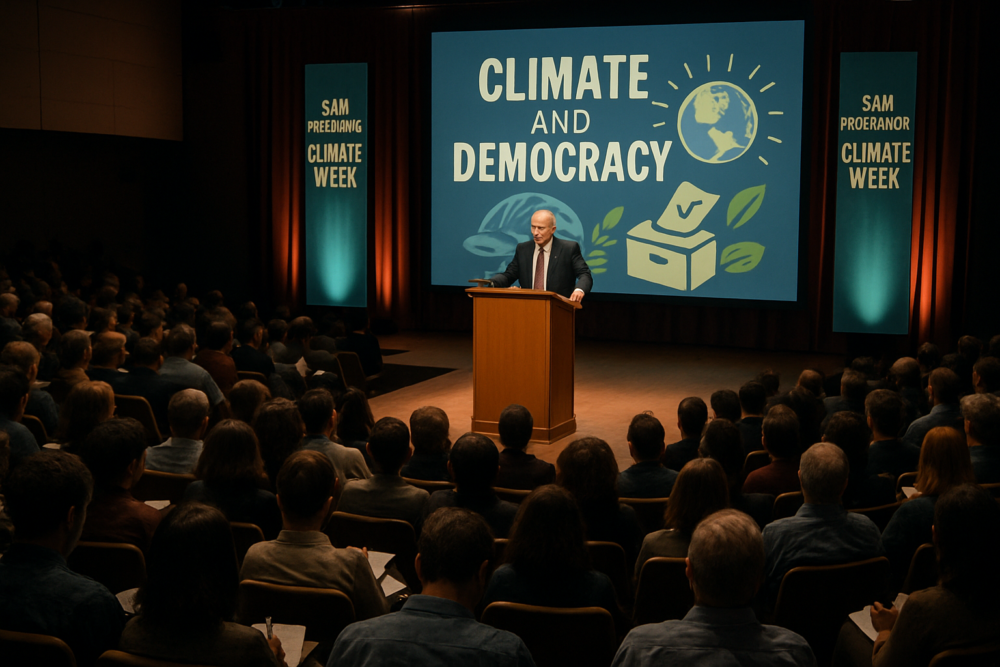
San Francisco Climate Week: Gore’s Stark Warning and the Battle for Truth in U.S. Democracy
During a charged keynote address at San Francisco’s Climate Week, former Vice President Al Gore (Democratic Party) issued a stark warning about the state of American democracy and climate action. Speaking at the Exploratorium science museum, Gore drew historical parallels between the Trump administration’s manipulation of facts and the propaganda tactics employed in Nazi Germany, referencing the work of philosopher Theodor Adorno. While Gore emphasized the uniqueness and horror of Hitler’s Third Reich, his remarks underscored the urgency of protecting democratic norms in the face of misinformation—a fight deeply intertwined with efforts to combat the climate crisis.
Gore argued that the current assault on truth by high-ranking officials threatens the very foundation of a functioning democracy, which is essential to tackling challenges such as climate change. He cited a litany of unfounded claims spread by the Trump administration, from assertions that coal is “clean” and wind turbines cause cancer to the false suggestion that rising sea levels are creating “more beachfront property.” Such distortions, Gore contended, are not merely errors in judgment but calculated efforts to sow doubt and stall progress on climate action.
Other prominent Democratic leaders, including former President Barack Obama (Democratic Party), Vice President Kamala Harris (Democratic Party), and former Secretary of State Hillary Clinton (Democratic Party), echoed these concerns in their own messages throughout Climate Week. The event, which drew policymakers, advocates, and scientists from across the nation, became a forum not only for advancing clean energy goals but also for reaffirming the connection between democratic integrity and scientific truth.
“I understand very well why it is wrong to compare Adolf Hitler’s Third Reich to any other movement — it was uniquely evil, full stop. I get it, but there are important lessons from the history of that emergent evil,” Gore said, stressing the dangers of normalized lying by those in power.
Meanwhile, the White House responded swiftly, with Communications Director Steven Cheung accusing critics of hypocrisy by saying, “those invoking Nazi comparisons are themselves guilty of such tactics.” This defensive posture has become emblematic of an administration that often rebuffs outside scrutiny, even as it doubles down on controversial narratives. Gore’s remarks, however, refocused attention on the role of citizens, activists, and scientists in defending both democracy and the planet.
In light of recent history, Gore’s critique is not without precedent: in 2018, he called President Trump’s environmental rollbacks “literally insane” and described Trump as “the face of climate denial” (source). The pattern of dismissing climate science in favor of short-term economic or political gains is, for Gore and many others, a mark of a deeper crisis of governance and public trust.
Climate Misinformation, Erosion of Democracy, and the Push for Accountability
At the core of Gore’s address was a sobering recognition that the fight against climate change is inseparable from the fight for honest and transparent government. The Trump administration’s high-profile reversals of clean energy initiatives, withdrawal from the Paris Agreement, and repeated downplaying of extreme weather have left a legacy that many environmental leaders now see as a blueprint for disinformation campaigns worldwide.
These actions, according to Gore, do more than hinder environmental progress: they numb the public to the urgency of action, foster cynicism, and embolden anti-democratic actors both in and outside of government. The climate movement, as he framed it, is now not only about carbon reduction but about resisting authoritarian tendencies that undermine reasoned debate and democratic participation.
Event organizers and attendees voiced strong agreement with Gore’s thesis. Many scientists at Climate Week cited their own experiences with threats, funding cuts, and public attacks that escalated during the prior administration. They described a hostile climate for basic research and public education on climate change, which has required new strategies of outreach, coalition-building, and digital literacy.
“The lesson from history is clear: unchecked propaganda and persistent attacks on truth can erode the bulwarks of democracy faster than many realize. Combating climate change requires a citizenry that values evidence over ideology,” commented Dr. Leigh Andersen, a climate policy analyst in attendance.
For many progressives, the stakes go beyond environmental policy. There is a growing awareness that climate justice and democracy are mutually reinforcing ambitions: only a healthy democracy can enact bold, equitable policies to confront the climate crisis. Conversely, as Gore noted, attacks on democratic norms often coincide with attacks on environmental regulation and civil rights. This intersectional view has given rise to new alliances between voting rights groups, environmental organizations, and social justice movements—all determined to counteract misinformation and defend the institutions that sustain progress.
This dynamic was mirrored at the federal level even before Gore’s latest speech. In 2020, then-presidential candidate Joe Biden (Democratic Party) compared President Trump to Nazi propagandist Joseph Goebbels, stating, “Trump is sort of like Goebbels. You say the lie long enough, keep repeating it, repeating it, repeating it, it becomes common knowledge” (source). The invocation of such historical analogies is intended not as hyperbole, but as a call to vigilance—an insistence that democracy cannot be taken for granted.
San Francisco’s Climate Week illustrated how the climate debate now serves as a crucible for defending democratic values and the pursuit of truth in public life. The event’s organizers made clear that advancing clean energy requires defeating not just fossil fuel interests, but the networks of disinformation that empower them.
Historical Parallels, Policy Implications, and the Path Forward
The controversy surrounding Gore’s Nazi Germany analogy draws attention to the ways in which history can illuminate modern dangers. While Gore was careful to acknowledge the singular nature of the Holocaust and the Third Reich’s horrors, he insisted that “there are important lessons from the history of that emergent evil.” Namely, that societies can slide toward authoritarianism not through sudden shocks but through a gradual normalization of falsehood, scapegoating, and public apathy.
Democratic societies have faced similar inflection points in the past, from the McCarthy era to the struggle for civil rights. Each time, the defense of truth and the expansion of civil participation have proven essential. Today, the spread of misinformation—supercharged by social media and partisan echo chambers—poses a new kind of threat, one that progressive leaders argue must be met with organized resistance at every level.
Key policy responses now gaining momentum include expanded support for science education, public funding for independent journalism, and legislative initiatives to counter foreign and domestic disinformation. Environmental advocates are also emphasizing participatory approaches, ensuring that marginalized communities most affected by climate impacts have a seat at the policymaking table.
“Every citizen has a role to play in confronting the dual threats of climate change and democratic backsliding. Progress is possible, but only if we insist on honesty and mutual respect as the basis for collective action,” said Alicia Reyes, a grassroots climate organizer.
Looking forward, the lessons of San Francisco’s Climate Week suggest a renewed sense of urgency—not just to accelerate decarbonization, but to reinforce the democratic habits and values that make meaningful climate policy possible. As the midterm and presidential elections approach, progressive leaders are doubling down on messaging that weds environmental and democratic resilience, making clear that the two are fundamentally linked.
The fight for truth, Gore and his allies argue, is not a distraction from climate action—it is the precondition for its success. Recognizing the dangers of propaganda, challenging the normalization of lies, and uplifting the principles of open, evidence-based governance will determine whether the nation can meet the gravest challenges of this era.