

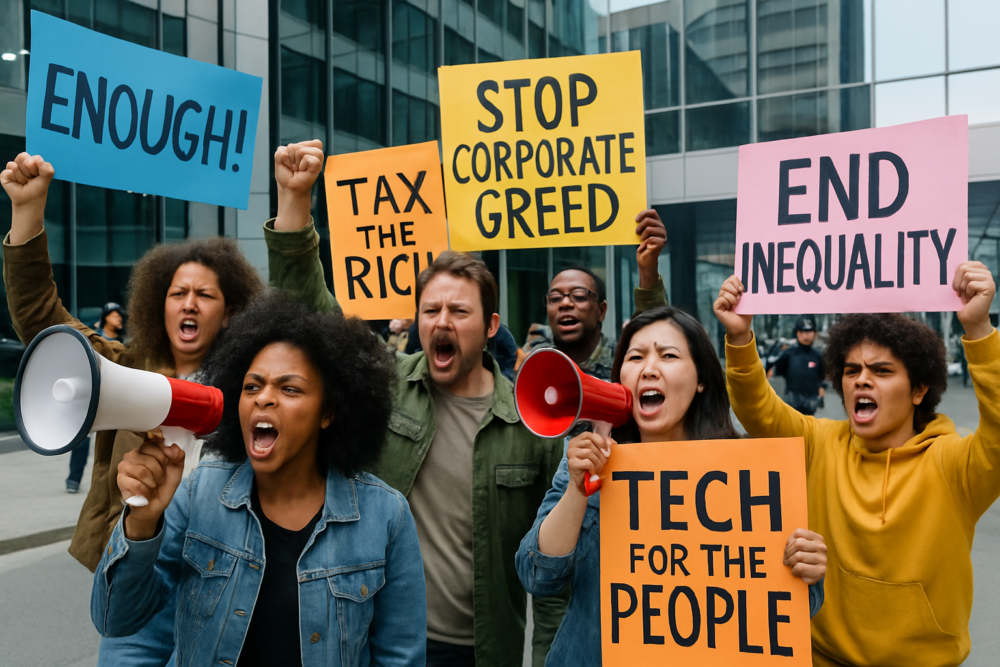
Public Outcry Over Elon Musk’s Political Clout and Economic Disparities
The phrase “global protests against Elon Musk” has acquired renewed significance in recent months, as demonstrations spanning multiple continents call attention to the entrepreneur’s growing political influence and the ever-widening wealth gap. In London, activists gathered for a high-profile performance, artful as much as adversarial, where a group called ‘Everyone Hates Elon’ used sledgehammers to dismantle a 2014 Tesla Model S. The vehicle, destined for the scrapyard, was provided by an anonymous donor. Organizers declared their intent was more than spectacle—it was a deliberate provocation, hoping to open conversations about how billionaire power distorts public priorities, especially as figures like Musk wield increasing control over technology and policy.
At the core of the action was a critique of what protesters see as unchecked wealth and deeply political entanglements. The demonstration, held on Cosmonautics Day for symbolic resonance, featured not only the destruction of the Tesla but also an ‘Elon Musk air dancer,’ signaling the carnival-like nature of public dissent today. As part of their effort to merge protest and charity, organizers announced that the remains of the Tesla will be auctioned to support local food banks, tying direct action to tangible community benefit.
Other cities have experienced their own waves of anti-Tesla sentiment; in the United States, Tesla vehicles have been vandalized with disturbing imagery and graffiti, often referencing the societal animosity some feel towards tech magnates. This escalation underscores a growing frustration with what critics perceive as billionaire overreach and a lack of accountability at the top of global industry. While the London protest stood out for its creativity and charitable impulse, the international echo suggests a shared unease about the direction of tech-driven capital accumulation and political influence.
“By smashing luxury cars and putting the remains to good use, we’re making the point that these symbols of excess can become resources for those left behind by the system,” declared one participant, summing up the event’s activist ethos.
Musk’s perceived alignment with far-right politics and reported support for the Trump administration were major motifs animating the crowd. As activists called for greater scrutiny and public interest regulation of billionaire power, the protest amplified a message that collective action—even symbolic—can push conversations previously relegated to the margins.
Debate Intensifies: Starlink, Ukraine, and the Ethics of Tech Power
The impact of Musk’s political reach is felt well beyond symbolic car-smashing in London. On the international stage, his company Starlink has become the subject of heated debate in the context of the Russia-Ukraine conflict. Humanitarian organizations and Ukrainian officials have expressed alarm at Musk’s decisions regarding the availability—and potential disabling—of Starlink satellite services during critical military operations. In September 2023, Musk admitted to refusing a Ukrainian request to activate Starlink over Crimea, fearing this could escalate the war dramatically. This decision drew widespread condemnation from Ukrainian leaders, who accused the entrepreneur of gambling with lives on the battlefield.
As the war ground on, accusations mounted. Ukrainian officials even went as far as to accuse Musk of enabling Russian attacks on civilians by limiting Starlink. One government spokesperson described his actions as ‘committing evil’—a stark indictment of private sector involvement in military affairs. At the same time, some U.S. officials, like Secretary of State Marco Rubio (R), have argued against the idea of finding alternatives to Musk’s services, suggesting its critical role in Ukraine’s defense. The debate reflects a broader tension: can any single business magnate be entrusted with decisions that affect the fate of nations?
Musk’s influence underlines how technological infrastructure is now deeply interwoven with geopolitical competition. Recent accusations in early 2024 also raised concerns about Starlink’s alleged cooperation with Russian forces, although Musk denied any business dealings with Moscow, insisting the company’s neutrality. These swirling narratives reinforce why many activists feel compelled to act: the concentration of such consequential power in private hands leaves open troubling risks for global security and democracy.
“We need strong, democratic safeguards over technologies that decide life and death in modern conflict,” said Olena Ivashchenko from Campaign for Ukraine at a November rally, channeling growing anxieties across Eastern Europe and beyond.
The sense that public interest must come before private profit is at the heart of these protest movements. As global citizens grapple with how much trust to invest in tech titans, the call for regulatory reforms and safeguards grows impossible to ignore.
Historical Patterns, Policy Context, and the Road Ahead for Billionaire Accountability
Protests targeting the political and economic influence of the world’s wealthiest are not new. From the anti-globalization movements of the 1990s to the Occupy Wall Street encampments a decade ago, public dissent has repeatedly focused on the dangers of concentrated power and the perceived erosion of democratic checks and balances. What marks the current wave is the directness and creativity: whether smashing a Tesla in London or projecting anti-billionaire messages onto corporate headquarters, activists are blending spectacle with substance, aiming for both viral attention and structural change.
Efforts to hold billionaires like Musk accountable have also entered the political arena. Lawmakers in the U.S. and EU regularly debate higher taxes for the ultra-wealthy, more robust antitrust enforcement, and transparency requirements for those whose decisions reverberate worldwide. Yet, the sheer scale of Musk’s assets—spanning automotive, space, digital, and infrastructure—often outpaces existing regulatory frameworks. In March 2025, Musk himself suggested sanctioning Ukrainian oligarchs as a path to peace, a move seen by critics as both self-serving and illustrative of the moral ambiguities that come with vast personal influence (see report).
The ongoing protests may catalyze further scrutiny of how private fortune intersects with public good. While the spectacle of smashed luxury cars draws headlines, the underlying questions—about the responsibilities of immense wealth and the future of democratic oversight—are hardly ephemeral. The journey toward equitable solutions, activists argue, requires sustained engagement across society.
“Every time we take action, whether small or large, we open the door for meaningful change. Billionaire accountability isn’t a distant dream—it’s a collective project we can build,” said a London protest organizer.
Policy experts point to the need for international cooperation on taxation and transparency, reimagining public ownership or oversight of critical infrastructure, and supporting grassroots innovation—like the emergence of eco-friendly consumer choices such as chemical-free cleaners—to shift consumption and production away from oligarchic control. These pathways, though challenging, testify to a progressive optimism that with enough momentum, today’s discord can become tomorrow’s reform.