

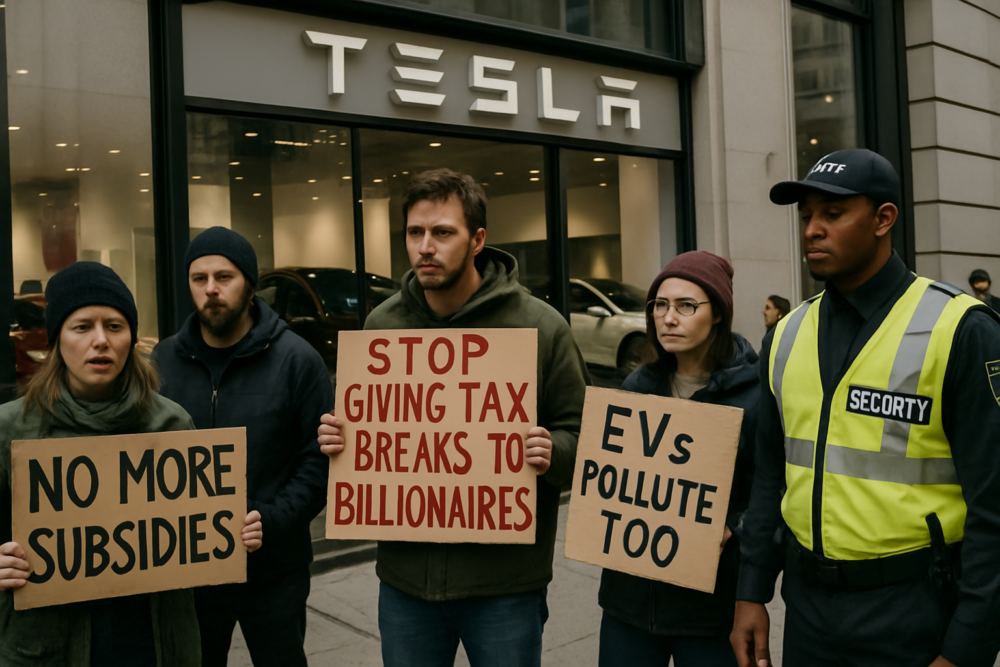
Growing Political Backlash and Public Protest Against Tesla
Over the past several months, Tesla, once a beacon of green innovation and American ingenuity, has increasingly found itself at the center of a complicated sociopolitical storm. This dynamic is seen most acutely in the surge of anti-Tesla protests and vandalism across the United States and beyond, driven in part by CEO Elon Musk’s highly publicized association with former President Donald Trump (Republican) and other conservative figures. Recent incidents in places like Bradenton, Florida and at locations such as Aventura Mall indicate that tensions are rising, with Tesla owners and vehicles being directly targeted in acts reflecting the nation’s deepening cultural and political divides.
In Bradenton, Florida, police are investigating a case where a suspect inflicted at least $7,000 in damage to three Teslas, highlighting not only the intensity of the backlash but also the increasing financial burden such actions place on individuals and communities. Meanwhile, in Aventura, a Tesla owner discovered gum smeared across his car, reporting that he felt targeted simply for driving the brand—an experience that speaks to the personal cost borne by those caught at the intersection of business leadership and national politics.
“I never thought something like this would happen just because I drive a Tesla,” the Aventura owner said, expressing dismay at the intrusion into what he saw as an apolitical choice. “But the atmosphere has changed.”
Not isolated to Florida, these incidents are echoed by protests at Tesla dealerships in Cherry Hill. Here, drivers have reported aggressive behavior, with police departments closely monitoring the situation. The escalation into violence and vandalism underscores the urgency for local authorities and community leaders to find constructive paths forward.
What makes this trend particularly noteworthy is how it blends the personal with the political. The acts against Tesla vehicles are not merely property crimes; they serve as expressions—however misdirected—of wider anxieties about technology, leadership, and the direction of American innovation.
Tariff Policy, Market Volatility, and Tesla’s Strategic Position
While the protests capture the immediate, ground-level discontent, global forces are simultaneously shaping Tesla’s future in significant ways. Recent trade policy shifts, especially those tied to Trump-era and Biden administration tariffs, have had a profound impact on the electric vehicle (EV) market as a whole. Notably, Tesla’s business model offers a layer of resilience: all vehicles sold in the United States are manufactured domestically, primarily in California and Texas. This means that, unlike many competitors, Tesla remains unaffected by the new tariffs targeting cars built in Mexico. This domestic production model offers clear economic advantages at a time when international trade uncertainty threatens to increase costs for both companies and consumers.
As recently reported, Tesla’s operations are not exposed to new U.S. tariffs aimed at vehicles built in Mexico, giving the company a leg up over foreign automakers and American brands that rely more heavily on cross-border manufacturing. However, broader policy waves are still roiling the market: the announcement of tariffs sent Tesla’s stock into a nosedive, reflecting how investor sentiment often tracks not just company fundamentals, but also public perception and regulatory developments.
“The market volatility is telling,” said Dr. Janet Rojas, an analyst specializing in the automotive sector. “Even when a company is technically protected from a specific policy, the ‘headline risk’—the public’s response—can drive valuations sharply downward.”
Such fluctuations are amplified by cultural signals emanating from political leaders. Governor Tim Walz (Democrat) of Minnesota publicly mocked Tesla’s declining stock prices, a move that illustrates how Tesla’s challenges now transcend commerce and enter the realm of political theater. This climate complicates Tesla’s brand image, which was once associated almost exclusively with cutting-edge technology and environmental impact. Now, it’s as much about the CEO and his politics as the cars themselves.
The interplay between trade rules, market reactions, and cultural values continues to evolve. Tesla’s exemption from Mexican tariffs may provide short-term relief, but broader boycotts of American products, especially in reaction to Trump’s trade moves, ensure that the company’s international prospects face continued scrutiny and uncertainty.
Historical Context, Societal Tensions, and Possible Paths Forward
To fully understand the current Tesla backlash, it’s crucial to explore the historical context of tech-driven social change, the politicization of green technology, and the increasingly blurred lines between executive leadership and personal branding. In earlier years, Tesla was almost universally championed as a disruptor, loved by environmentally conscious consumers, progressive policymakers, and early tech adopters. The company’s success—and transformative role in pushing forward electric vehicle adoption—seemed nearly immune to the controversies plaguing traditional automakers.
However, as CEO Elon Musk’s visibility and vocal support for political figures like former President Trump (Republican) grew, Tesla became a lightning rod for both praise and criticism, often disconnected from the company’s actual products or environmental mission. The convergence of culture war dynamics with consumer choices now means that even the simple act of purchasing or driving a certain car brand can be interpreted as a political statement.
As one policy researcher notes, “We’re in an era where corporate leadership is a proxy for broader debates about values—not just product innovation. That’s changing how people act, which companies they support, and how they express dissent.”
Policymakers have also contributed to this climate, sometimes intentionally, sometimes as bystanders. Governors and local leaders—like Tim Walz (Democrat) of Minnesota—using Tesla’s stock price as rhetorical fodder exemplifies how economic challenges can quickly be appropriated for political purposes. Such moves risk further destabilizing the company’s public standing and muddying the waters for consumers genuinely invested in sustainability and innovation.
Historically, major U.S. companies have weathered periods of protest and boycott, often emerging more focused and mission-driven. The challenge—and opportunity—now facing Tesla and stakeholders is to recenter the conversation around community, equity, and climate action. Building bridges between divided communities, ensuring protections for car owners, and striving for transparent leadership may help repair some of the rifts that have emerged. For the larger EV sector, this turbulent moment offers a chance to reaffirm the value of American innovation, grounded in respect for both social progress and individual choice.
With careful leadership and continued engagement by citizens, policymakers, and business leaders alike, the path forward can still yield positive transformation for both Tesla and the broader movement toward a clean energy future.