

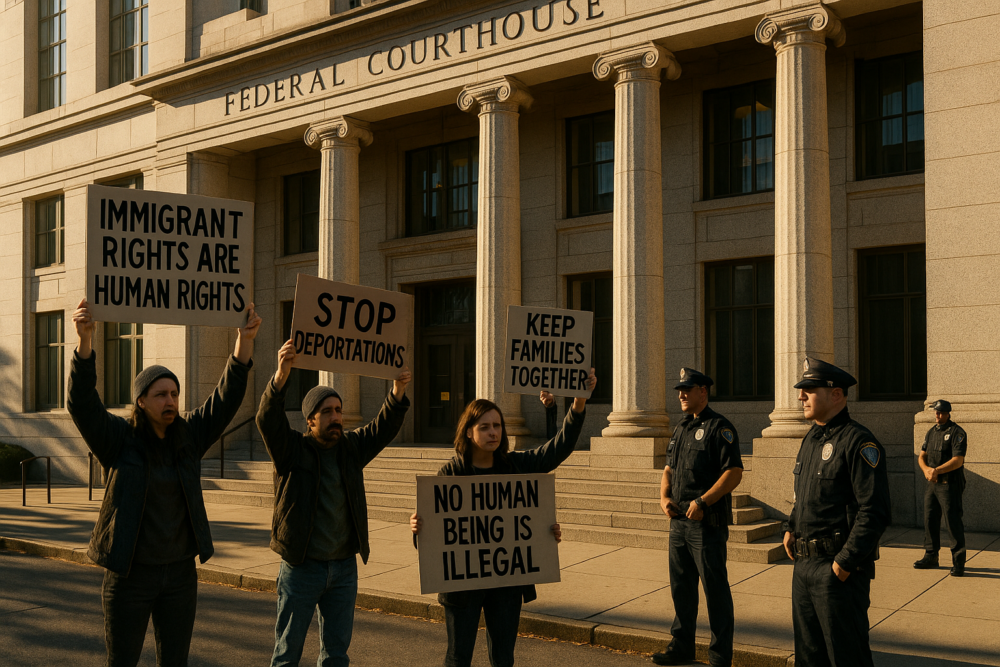
Overview: Courts Block Trump Deportations and the Fight for Due Process Rights
The ongoing legal clash over the Trump administration’s use of the Alien Enemies Act to expedite deportations has drawn national attention to the crossroads of immigration policy, due process, and civil liberties. At the heart of the issue is the administration’s controversial approach: leveraging a wartime-era law to deport Venezuelan nationals accused of affiliation with the Tren de Aragua gang. This has prompted urgent action by federal courts and set the stage for a landmark legal and moral struggle on U.S. soil. Federal judges in Nevada, New York, and Colorado have blocked the administration’s use of the Alien Enemies Act to deport Venezuelan nationals alleged to be gang members, citing due process and asylum rights concerns. These rulings highlight the judiciary’s crucial role as a safeguard for vulnerable populations at risk of deportation without a fair hearing.
The Trump administration’s March 2025 executive order specifically targeted alleged members of the Tren de Aragua, drawing rapid legal responses. Critics, including civil rights advocates and some lawmakers, argue the move not only disregards fundamental legal protections but also sets a dangerous precedent by reviving seldom-used portions of U.S. law. The administration justified its actions by citing threats posed by transnational criminal organizations, but legal experts counter that the Alien Enemies Act applies strictly during states of declared war—a status the U.S. does not have with Venezuela.
“We are witnessing extraordinary efforts to circumvent the very principles of justice that our system is intended to preserve,” said Laura Callahan, an immigration law professor and advocate. “If history teaches us anything, it is that due process matters most when it is least convenient for those in power.”
The courts’ initial interventions have already made tangible differences for asylum seekers like J.G.O., a pseudonym for a Venezuelan activist who faced dire threats if deported. Yet the struggle is far from over, as deportations have reportedly continued despite the pending litigation.
Main Narrative: Trump’s Aggressive Deportation Push and Legal Backlash
Legal battles have erupted across the nation as the administration presses forward with a hardline approach, even in the face of judicial orders. While court stays have temporarily halted many removals, some deportations reportedly proceeded regardless of these orders, leading a federal judge to find probable cause of contempt by the administration . This defiance has raised alarm among civil liberties groups, who warn of systemic erosion of checks and balances.
The administration’s focus on the Tren de Aragua—a notorious and violent Venezuelan gang—served as the central justification for the executive order. The Department of Homeland Security claimed that these actions were necessary to protect U.S. communities from transnational crime. However, legal challenges argue that the use of the Alien Enemies Act is unlawful, as the U.S. is not at war with Venezuela . As of March, over 130 Venezuelan nationals had already been deported to El Salvador, despite live court challenges and stays on the executive order’s enforcement.
The ongoing legal tug-of-war has resulted in real human consequences. The case of J.G.O., a Venezuelan dissident who had previously protested against Nicolás Maduro’s regime, underscores the risks inherent in expedited deportations. If returned, J.G.O. faced possible torture or even death due to his past activism.
“The government’s willingness to override judicial orders is not only alarming but also reveals a disregard for the basic rule of law,” said Marisol Rodriguez, director of a leading immigrant rights nonprofit. “We are committed to ensuring that due process and asylum protections are upheld for all individuals facing deportation.”
Meanwhile, U.S. District Court Judge Gloria Navarro’s temporary block on deportation has postponed at least one asylum hearing until June 20, reinforcing the essential role of the federal judiciary in protecting constitutional rights. On the other side, the U.S. Justice Department has appealed the potential contempt finding, indicating a protracted legal battle ahead.
President Trump (Republican) has not stopped at targeting noncitizens. In a radical escalation, he has publicly floated the idea of deporting ‘homegrown criminals’ by sending violent U.S. citizens to El Salvador—a move legal scholars and advocates have described as unconstitutional. The idea has been widely condemned across the political spectrum, yet strikingly, El Salvador’s President Nayib Bukele has indicated willingness to accept such deportees if the U.S. proceeds. Such proposals demonstrate the extent to which immigration debates have become a crucible for broader discussions about civil rights, nationality, and the future of American justice.
Context and Broader Consequences: The Alien Enemies Act, Precedents, and the Path Forward
To fully understand the current legal storm, it is essential to revisit the Alien Enemies Act’s origins and its historical misuse. Enacted in 1798, the Act has rarely featured in modern U.S. policy; its most infamous application occurred during WWII, when it was used against Japanese, German, and Italian nationals. Scholars and policy experts note that such wartime measures have been repeatedly discredited and condemned for violating civil rights in the name of national security. The renewed use of the statute has drawn sharp criticism from legal organizations and legislators, who see echoes of past injustices.
The crux of the legal challenge lies not only in technical interpretations—such as whether a state of war is a necessary precondition—but also in profound questions about due process and the rule of law. Even as the Trump administration (Republican) frames its actions as vital for security, opposition voices stress the humanitarian consequences for people fleeing violence and political persecution in their homelands. Widespread challenges have now arisen from both grassroots organizations and national civil liberties groups, sparking coordinated campaigns to defend due process and asylum protections.
“These aggressive deportation policies have triggered widespread legal and civil liberties challenges that will shape the discourse for years to come,” wrote a senior editor at The Atlantic, reflecting a broad consensus among advocacy groups. “This is a pivotal test for America’s commitment to justice and equity, particularly for the most vulnerable.”
Looking forward, the courts’ willingness to intervene presents a beacon of hope for change. As Judge Navarro (Nevada) and others continue to scrutinize the administration’s moves, advocates believe this struggle could yield significant legal precedents affirming that all people—regardless of nationality—deserve fair hearings and humane treatment. America’s core values of justice and compassion must remain at the center of immigration reform debates, with every effort made to ensure no one is stripped of their rights in the name of security. The current fight demonstrates that real progress is achieved not in isolation, but through the collective action of informed, engaged communities, legal advocates, and a vigilant judiciary.