

Stock Market Surge After Trump’s Tariff Announcement Raises Insider Trading Questions
The intersection of presidential power and Wall Street has come under sharp scrutiny following President Donald Trump’s (Republican) recent pause on tariffs—a decision that sent financial markets soaring and prompted leading Democrats to demand accountability. With progressive leaders focusing on transparency and economic justice, concerns have quickly been raised regarding whether Trump and his inner circle may have leveraged privileged information for personal gain, reigniting the national debate over ethics and market fairness.
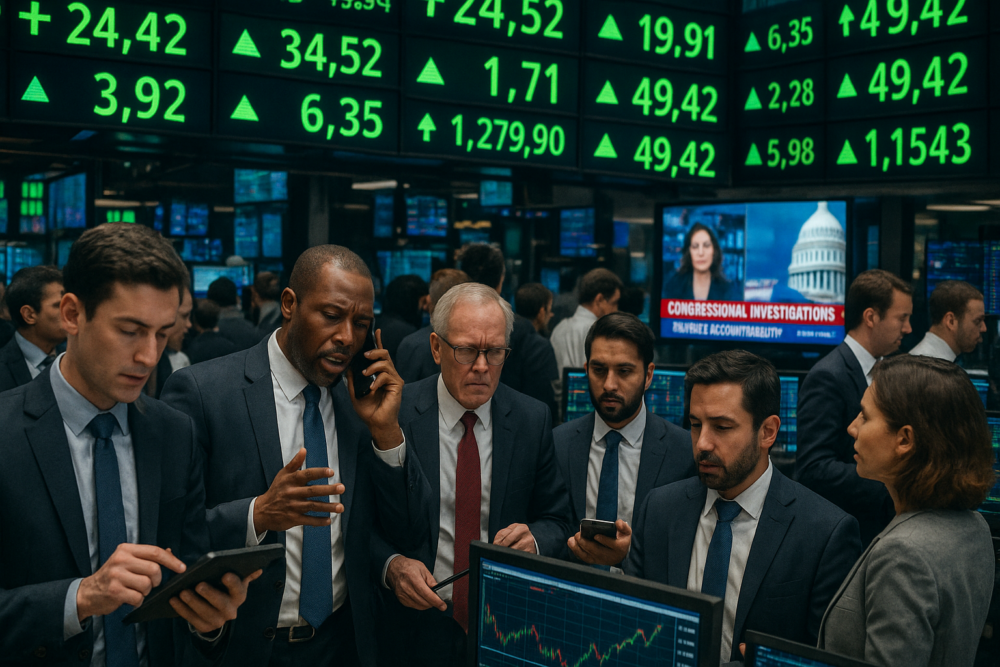
Early on April 9, 2025, Trump posted on Truth Social, encouraging his followers by bluntly stating, ‘THIS IS A GREAT TIME TO BUY!!! DJT.’ Hours later, he officially announced a sweeping 90-day pause on nearly all tariffs, an unexpected move that led to a 9.5% surge in the S&P 500 and restored an estimated $4 trillion in market value, according to the Associated Press.
Senator Chris Murphy (Democratic) quickly flagged how the timing of Trump’s post—just hours before the official policy announcement—could hint at insider knowledge and market manipulation, particularly as shares in Trump Media and Technology Group rocketed up by nearly 22%. The scale and immediacy of these financial shifts have, understandably, intensified the call for investigation.
“If the president or anyone in his orbit capitalized on advance knowledge of a major policy change, that’s not just unethical—it’s potentially unlawful,” Senator Murphy said during a Senate hearing.
This deep unease reflects broader anxieties about fairness in a system where the lines between public service and private gain can blur. Many progressives believe robust checks are essential to protect everyday investors and ensure the powerful cannot enrich themselves at the expense of public trust.
Democratic Lawmakers Demand Investigation Amid Market Manipulation Accusations
Democratic leaders in Congress have not waited for answers to emerge organically. Senator Adam Schiff (Democratic) officially called for a congressional probe into whether Trump’s actions constitute insider trading or market manipulation following the market’s sharp rally. Schiff emphasized the potential legal and ethical violations inherent in a scenario where a president directly benefits from policy-driven market swings, whether through personal investments or information relayed to close associates.
The largest gains from the rally were reported among high-profile individuals—most notably, Elon Musk, who amassed nearly $30 billion in personal wealth the same day as the announcement, driven by the surge in Tesla’s stock. This windfall has raised eyebrows on both sides of the aisle, though progressive critics see it as a clear sign that the system is tilted in favor of the already-wealthy.
Lawmakers such as Senators Murphy and Schiff have publicly questioned who in Trump’s circle may have had advance notice of the tariff decision and whether they took advantage of that knowledge. As Common Dreams reports, these lawmakers are pressing agencies like the Securities and Exchange Commission to closely examine trading patterns and communications in the hours preceding the announcement.
“This isn’t about partisanship—this is about the rule of law,” Schiff insisted in a floor speech. “We have a duty to ensure no one, not even a sitting president, can manipulate markets for personal gain.”
However, not all voices agree on the substance of the allegations. Jordan Belfort, the self-styled “Wolf of Wall Street,” argued on multiple outlets that Trump’s use of public messaging does not constitute insider trading unless confidential information was privately conveyed to select individuals. While legal scholars remain divided on this interpretation, the progressive position urges action over apathy, especially given the stakes for small investors and public confidence.
Historical Context and Policy Implications for Market Accountability
The intertwining of presidential decisions and financial markets is not new—but the extent and transparency of this relationship have drawn greater concern in recent years. Historically, policies that swing the markets have prompted regulatory reforms, yet allegations of abuse are rarely so directly connected to a sitting president’s public communications.
To fully grasp the risk, consider the 2025 context: Trump’s abrupt 90-day tariff pause was reportedly influenced by alarming developments in the U.S. bond market and direct consultation with Treasury Secretary Scott Bessent. This suggests a pattern where high-level financial and political actors shape policy in closed circles, often outside public scrutiny.
As Axios reported on April 22, President Trump has since indicated a softer approach to upcoming trade negotiations with China, hinting at a potential long-term de-escalation. Yet, the speed with which financial markets react to such pronouncements, and the corresponding wealth disparities that result, serve as a reminder of the need for stringent oversight and transparency.
“Unchecked power at the intersection of public office and private investment can only erode faith in democracy and fair markets,” said a spokesperson for Public Citizen, a progressive watchdog group.
While the legal path—whether these actions meet the threshold for prosecution or regulatory discipline—remains uncertain, this episode starkly illuminates the importance of insulating public policy from personal enrichment. Calls for stronger conflict-of-interest rules, blind trusts, and penalties for undisclosed trading by government officials or their relatives are mounting from advocates of good governance.
The hope for meaningful reform persists. By shining a persistent spotlight on who benefits from government decisions, civic society and lawmakers can help ensure that economic opportunity is shared more equitably and that the public’s trust in democracy remains intact.