

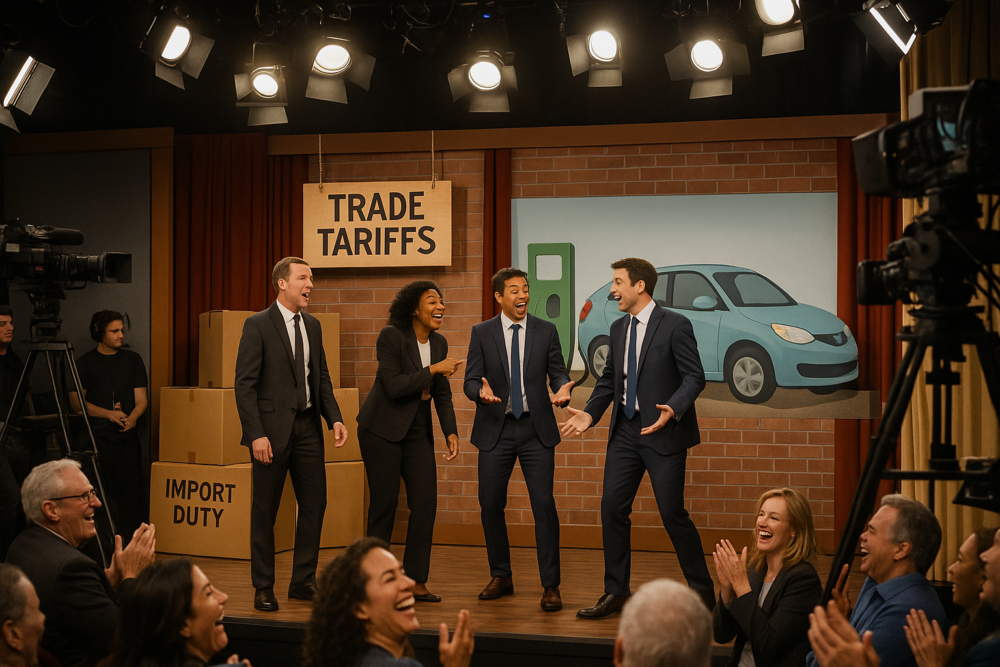
SNL Uses Satire to Spotlight Trump Tariffs and Tesla Challenges
Saturday Night Live (SNL) once again proved its knack for capturing the nation’s anxieties and headlines through comedy, this time zeroing in on President Donald Trump’s (Republican) sweeping new tariffs and the ongoing turbulence at Tesla. In an era where late-night humor often acts as a mirror for the American psyche, SNL’s recent episode did more than entertain—it invited viewers to grapple with the social and economic confusion that has stemmed from recent federal policy shifts and high-profile corporate missteps. Focusing on the unpredictable consequences of the tariffs and public scrutiny of Tesla’s market position, the episode turned news into shared laughter while quietly suggesting that collective action and vigilance remain vital.
The skit at the heart of the broadcast featured James Austin Johnson’s uncannily accurate Trump impersonation, parodying the randomness of recent tariff announcements. With a nod to the economic uncertainty pervading kitchen tables nationwide, Johnson’s Trump joked about a future so dire Americans might end up eating their pets, coining the phrase ‘Make America Great Depression Again.’ The sketch playfully derided the seemingly arbitrary nature of the tariffs, likening them to ‘random numbers’ reminiscent of the cryptic television show ‘Severance.’ This biting analysis came amid real-world concerns over the actual economic consequences of the tariffs, as reflected by a sharp $6 trillion drop in the stock market over just two days. The segment’s irreverent energy was matched by its topicality, bringing urgent policy debates directly into the realm of pop culture.
On April 12, 2025, Saturday Night Live (SNL) aired a sketch titled ‘The White Potus,’ parodying HBO’s ‘The White Lotus,’ to satirize the Trump family’s role in the economic turmoil caused by President Donald Trump’s newly imposed global tariffs. (The Atlantic)
Adding to the comedic chaos, Mike Myers’ Elon Musk introduced viewers to a bizarre new ‘self-vandalizing’ Tesla, equipped with AI graffiti tools—a tongue-in-cheek reflection of both Tesla’s latest controversies and the real attacks on its vehicles. The skit also touched on public unrest, as musical guest Lizzo wore a “Tariffied” shirt, blending humor with a pointed commentary on how policy decisions are reverberating far beyond Washington. These moments captured the absurdity of current events while underscoring the very real anxieties facing American households and workers.
Details of the SNL Skit: Humor as Social Commentary on Economic Policy
SNL’s creative team has long balanced satire with social commentary, using parody to unpack the complexities of new legislation and its sometimes unforeseen fallout. With their playful jab at Trump’s tariffs, the show illuminated the confusion swirling around the policy’s rollout. By referencing the randomness of the tariff numbers and suggesting a possible new economic depression, SNL positioned itself as a vantage point for frustrated citizens seeking to make sense of political decisions that have immediate, tangible effects.
Colin Jost, anchoring the Weekend Update desk, underscored the seriousness beneath the laughter. As he cited the sharp, two-day $6 trillion loss in stock value, the segment blurred the lines between parody and reality, driving home just how deeply these policies affect real Americans. By weaving together present-day headlines and comedic exaggeration, SNL reminded viewers that the economic uncertainties are not the stuff of fiction—or mere punchlines. Through humor, the show highlighted that policy choices, even those made with nationalist bravado, can sometimes cut deepest at home, impacting jobs, savings, and the cost of living for millions.
Meanwhile, the Tesla parody felt especially pointed in the wake of recent reports of vandalism against Tesla vehicles and the company’s struggle with stock volatility and public relations. Musk’s character, played by Myers, unveiled the ‘self-vandalizing Tesla’ as a wry commentary on real-life incidents where vandals have faced federal and hate crime charges for targeting Tesla cars. The absurdity of an AI car drawing graffiti on itself underscored the confusion and frustration some feel toward the automaker’s recent headlines, including CEO Elon Musk’s (Independent) controversial political endorsements and erratic public behavior.
The episode criticized the ongoing attacks on Tesla vehicles, where vandals have faced federal and hate crime charges for damaging cars, tying this to Musk’s recent controversial political endorsements. (source)
As if to punctuate the episode’s blend of current affairs and showbiz spectacle, the sketch also lampooned country singer Morgan Wallen’s recent SNL walk-off. Johnson’s Trump borrowed Wallen’s viral phrase “Get me to God’s country”—first posted on Instagram after Wallen left the stage without explanation—and turned it into a punchline that resonated with viewers who have followed the unfolding drama. This meta-humor provided not just comic relief but also an example of how pop culture and political discourse are inexorably linked.
Historical Context and Broader Impact: SNL, Political Satire, and Social Engagement
SNL’s willingness to satirize the intersection of politics, business, and popular culture is nothing new—but the stakes have grown during times of economic stress and rising political polarization. Throughout its history, the show has served as a platform for critical engagement with policy debates, helping to demystify complex issues for a mass audience and sparking conversations that extend far beyond Studio 8H.
The use of humor to process and critique economic turmoil is a recurring theme in American culture, especially when policy decisions produce far-reaching repercussions. SNL’s “White Potus” sketch, which drew on the aesthetic and themes of HBO’s “The White Lotus,” painted the Trump family as luxury tourists “summering on the decks of a sinking economy.” This literary comparison not only amplified the sense of economic precarity but also invited viewers to question who shoulders the burden during national crises. Such satire places a spotlight on the uneven impacts of trade wars, tariffs, and executive orders while inviting audiences to empathize with those affected.
On March 29, 2025, country music star Morgan Wallen walked off the SNL stage during the closing credits without interacting with cast members, sparking fan speculation and social media buzz. (CinemaBlend)
Within this context, SNL’s lampooning of Wallen’s exit and Lizzo’s “Tariffied” shirt both highlight how economic anxiety and cultural tensions bleed into mainstream entertainment. According to Music-News.com, referencing Wallen’s phrase in the April 7 episode served as both a wink to observant fans and a subtle critique of celebrity culture’s entanglement in national dialogue. These moments underscore the importance of freedom of expression, especially in times of political and economic unrest, and point to the powerful role comedy can play in both reflecting and shaping public understanding.
The episode ultimately challenges viewers to be more than passive consumers of news and entertainment; it offers an invitation to engage with, question, and—crucially—act in response to the issues confronting everyday Americans. While SNL’s jokes may sting for some, the show’s continued relevance lies in its ability to make us laugh through our discomfort and, perhaps, galvanize us to push for better solutions. As progressive audiences have long known, awareness is the first step toward movement—and in comedy, as in democracy, every contribution matters.